
By Elena Chin
“The greatest enemy of knowledge is not ignorance; it is the illusion of knowledge.” — Stephen Hawking
The total estimated cost of running the Department of Education has exceeded $4 trillion in inflation-adjusted dollars since its inception, ranking sixth among federal agencies in total spending. Since it was established in1980, department spending has increased by approximately 371% while overall spending increased by approximately 193%. In the last decade alone, the department’s estimated cost was $1.96 trillion, primarily due to COVID-19 relief fund allocations for remote learning support and health and safety protocols. While these funds were intended to benefit students, the biggest beneficiaries were large tech companies such as Google, Apple, Microsoft, and Zoom, not the students.
The department was established to ensure equal access to quality education, support state and local schools, collect and maintain records to guide educational improvement, and ensure federal education programs were effective and accountable. Over the years, the department’s role expanded to the point that many see it as federal overreach infringing on parental authority. It has become an inefficient, bloated bureaucracy that fails to deliver on its core mission and is out of touch with the needs of students, parents, and teachers.
If the Department of Education were a business, it would have been shut down long ago. Failure has consequences–while the department escapes them, sadly, our children do not. After decades of massive spending and expansion, the achievement gap between marginalized and low-income students and their peers have reached a historic high and academic outcomes across the board have consistently declined. The United States leads the world in spending per student, but has fallen behind other developed nations in math, reading, and science.
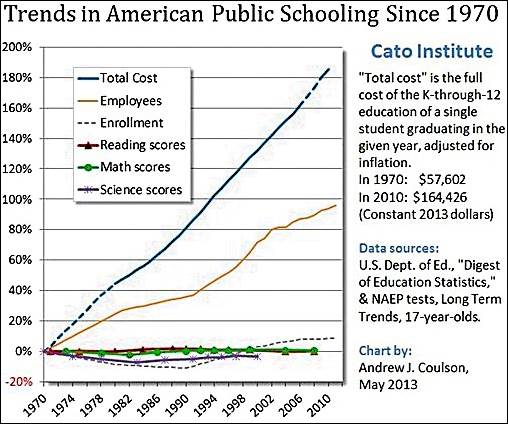
After decades of a one-size-fits-all approach to educational policy, the Department of Education has become an expensive failure that underdelivers for students and drains taxpayers. Achievement gaps for marginalized and low-income students have reached their widest point and academic outcomes have spiraled downward. Math and reading proficiency rates are historically low. According to the 2024 National Education Assessment of Educational Progress (NAEP), only 31% of fourth graders and 30% of eighth graders scored at or above the NAEP proficiency level in reading. With a 3% increase since 2022, only 39% of fourth grade students are at or above the proficiency level in math, and only 28% of eight grade students are proficient in math. High school graduation rates are hovering at around 85%, but 50 percent of high school graduates are unprepared for college and must take at least one remedial course. In 2023, only one in five freshmen met college readiness benchmarks in all four core subjects: English, reading, math, and science.
In the last several decades, tuition costs have increased by nearly 300% and student debt exceeds $1.7 trillion. Federal tuition assistance programs such as Pell Grants and federal student loans appear to be driving up the cost of higher education rather than helping students. According to sources such as Fordham Institute and Strommen Center, approximately 52% of recent U.S. college graduates are underemployed one year after graduation—meaning they hold jobs that typically don’t require a bachelor’s degree. Forty five percent of graduates are still underemployed ten years later. This trend indicates that students are graduating unprepared for the workforce because many degree programs prioritize ideology and political agendas over academic excellence the development of marketable skills.
The department’s pursuit of equity may have been well-intentioned but has resulted in a waste of tax dollars and negative outcomes for most students. It’s time to put students before systems. Educational options such as school choice, charter schools, education savings accounts, and homeschooling, and increased parental involvement expand educational opportunity and have proven to be successful. Yet they encounter fierce resistance from the Department and the left whose opposition to educational freedom–the civil rights issue of our time–is rooted in their own legacy of segregationist policies.