By Attorney Bobbie Anne Cox
May 18, 2025

It’s not news to anyone reading this article that we have been at war these past few years with evil forces that want to take down the United States, or at least permanently change us from independent and strong to submissive and feeble. There have been forces at work that are systemically trying to undermine every aspect of our lives, from our family ties, to our religious communities, to our education system, and most poignantly to our elections. This last category might be the most damning because it could hasten the hammering of the final nail into the coffin of our free society, if it is not stopped, and stopped soon.
Quite frankly, the integrity of our elections is under siege. The expansion of mail-in ballot voting (which is the least secure way to vote), “dirty” voter registration rolls that are illegally not being maintained and updated, ballot harvesting, social media and search engine censorship, and the influx of private sector persuasive funds, like Zuckerbucks, into what is supposed to be our sacred, “free and fair elections” has actually turned them into a crap shoot on who will win (and when, since election day is now election month). I’m sure you’ve all heard of these tactics before, to some extent or another. But there’s another blemish on our elections that is little known, since it is not yet widely used, (and I hope it stays that way, ultimately).
It’s called ranked choice voting, and if you haven’t yet heard of it, you need to know what it is and how it works so you can reject it if your state or city start talking about adopting it. (Ranked choice voting will be in effect in NYC for the June 24, 2025 Primary Election.)
In short, ranked choice voting is nothing more than a sleight of hand. For those of us who know what it is and how it works to undermine the will of the people, the name ranked choice voting brings to mind the image of a magician standing behind his makeshift, wooden table, expeditiously shuffling three, identical coconut shells around, cleverly asking his unsuspecting audience which shell is housing the elusive white ball beneath it. In other words, ranked choice voting is not what the proponents of this voting system say it is. To those nefarious players who want to forever shift our society from vivacious and prosperous to weak and wholly reliant on government giveaways, ranked choice voting is a great way for them to do so.
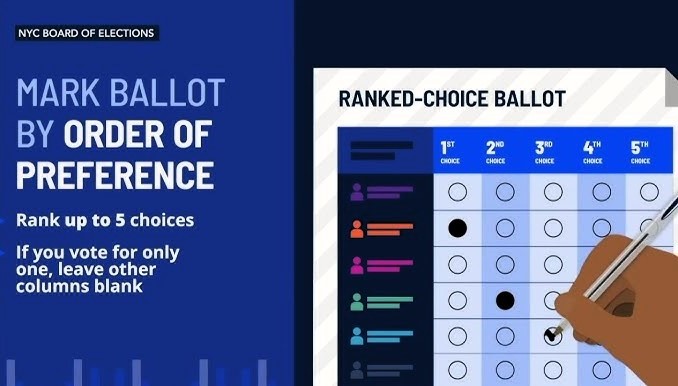
Here’s how ranked choice voting works: Instead of our standard election system, where the candidate who gets the most votes wins, ranked choice voting allows voters to vote for multiple candidates who are running for the same office, by ranking them in order of preference. If no candidate achieves more than 50% of the first place votes, then the candidate that receives the fewest first place votes is eliminated, and that candidate’s second place votes are allocated to the remaining candidates. So just to be clear, the votes of the other voters whose first choice candidate that was eliminated are re-allocated. These rounds of re-allocating second, third or fourth place votes from the bottom-up will continue on and on until one candidate finally gets a “majority” of the votes. Well, a majority of the remaining votes that haven’t been thrown out yet. Sound confusing? Don’t worry if you are scratching your head. I was too when I first read about it.
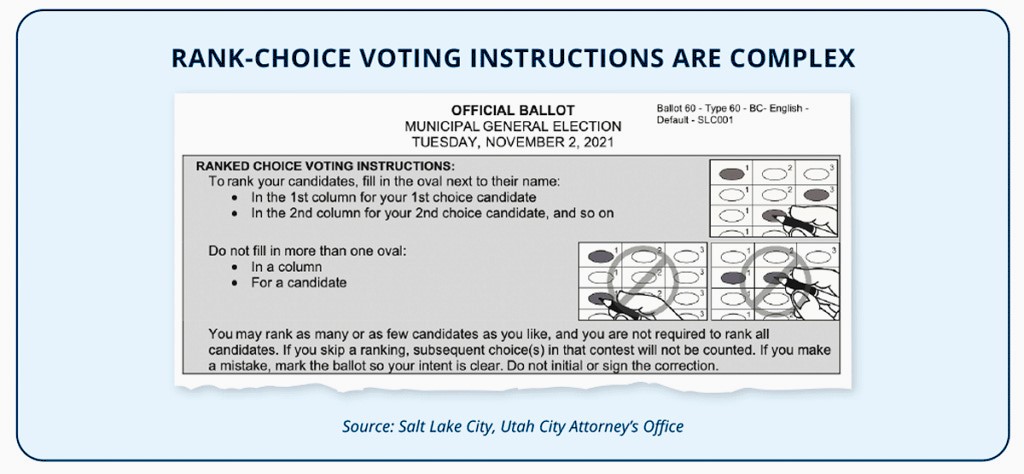
Think it will cause errors in the voting process due to confusion? Definitely. Think it will deter people from voting since the process is too confusing or intimidating? No doubt.
Hang on, it gets even more suspect. As you move through each round of the ranked choice voting tabulation, some ballots are declared “exhausted,” (read thrown out), as some voters’ remaining choices do not include candidates who are still in the race as voters’ other (2nd, 3rd, 4th) choices are being re-allocated to the candidates who are still standing. This absolutely disenfranchises “exhausted” voters, excluding them from having their vote counted in final rounds of the process. It also makes hand re-counts and audits virtually impossible.
Sound unfair? Dare I borrow a term from the left and call it “inequitable”… It is! With this system of voting, not all voters are having their vote weighted equally. Plus, some voters are literally having their votes tossed, whereby lowering the “total” number of ballots, whereby opening the door for someone who hardly anybody voted for to swoop in and win the race. Think I am exaggerating? Sadly, I am not.
For Example: Maine and Alaska are the only two states currently using this system of voting, though there are dozens of cities (like NYC and San Francisco) that also use it. Here is a real-life example of ranked choice voting causing the candidate who should have won, to lose:
The 2018 Maine 2nd Congressional election had 4 candidates running in it. After the initial vote, Bruce Poliquin was leading with a plurality of votes (45.6%) amongst the four candidates. However, since he didn’t have a majority, ranked-choice eliminations took place. The system determined that the candidates who “weren’t viable” had garnered 8.1% of the total votes. When those candidates were eliminated and votes shifted to next ranked-choices, Poliquin ended up with 49.5% of the vote, just short of the majority needed to win, and his opponent, Jared Golden, ended up winning with 50.5%. But Golden would have lost if the equitable (normal) voting system had been employed.
Rejecting Ranked Choice Voting: Of great note, we can clearly learn from others’ mistakes. Some jurisdictions previously adopted ranked choice voting laws but then repealed them following negative experiences. For example, after a rather unpopular mayor of Burlington was re-elected with only 29% of the first place votes, they then repealed the system and went back to the regular voting methods. In Washington state, Pierce County repealed ranked choice voting by a whopping 71%, and in Aspen, Colorado, it was rescinded by 65%.
North Carolina legislature got rid of ranked choice voting back in 2013. And believe it or not, in California, after the state legislature passed a ranked choice voting system, the long-time governor at the time, Jerry Brown, vetoed the bill. He felt it was overly complicated and confusing, and that it would deprive voters of “genuinely informed choice.”
Let us learn from others’ mistakes so we can avoid making similar, irreparable mistakes in the future… For as we have seen these past few years, having a bad leader in power can cause unimaginable and sometimes irreversible harm to our minds, our bodies, and our wallets.
This article is published with permission of Bobbie Anne Cox, the NYS Attorney who independently sued and initially defeated Gov. Hochul’s unconstitutional DOH regulation to place people in quarantine camps. Follow her at AttorneyCox.Substack.com or on X: @Attorney_Cox