By Ankush Bhandari
In the last week of April, when US President Donald J Trump claimed to have spoken to Chinese Premier Xi many times during the tug of trade war, the Media portrayed it as either a blatant misrepresentation or a result of confusion.
At that moment, U.S. Treasury Secretary Scott Bessent has rightfully downplayed these assertions, pointing out that the White House does indeed have options for tariff off-ramps. Such obfuscation will likely alienate Beijing, which has explicitly denied any on-going discussions. Nonetheless, China is proactively pursuing diplomatic avenues, including a recent delegation visit to Washington and discreet communications with U.S. think tanks for insights into the dynamics within Trump’s administration. Chinese state media emphasize unwavering resilience and a commitment to existing trade rules, with commentary invoking Mao Zedong to contextualize the on-going trade conflict.
On May 12th, the United States and China agreed to drastically roll back tariffs on each other’s goods for an initial 90-day period, which is a surprise breakthrough that has de-escalated a punishing trade war and buoyed global markets.
Trump Tariff Makes Chinese Economy Bleed
The recent wave of protests in China over factory closures starkly reveals the damaging effects of U.S. tariffs on a crucial sector that employs millions.
As the country grapples with a persistent property market crisis, soaring youth unemployment, and faltering consumer demand, the contraction of factory activity has reached alarming levels.
Hundreds of workers turned out to protest unpaid wages and what they described as unjust dismissals, Radio Free Asia reported[1].
The manufacturing Purchasing Managers’ Index (PMI) plunged to 49.0 in April, marking its lowest point since December 2023. A reading below 50 signals a contraction.
This crisis is directly fueled by the punitive 145% tariffs imposed by the U.S., leading to widespread order cancellations and production cuts across the industry.
One such company was Guangdong Shenzhen Weilixing Toys Co., a toy manufacturer based in Shenzhen. According to a video shared by @YesterdayBigcat, an X (formerly Twitter) user who frequently posts about China protests, the company abruptly announced its closure on May 6 after U.S.-bound orders ceased1.
Not just Trump needing an off-ramp but also one that China cannot afford, unless tolerating pain is a strategy and pain on the U.S. side may or may not come as they can try to buy toys somewhere else.
The Chinese economy is already struggling with weak domestic consumption and a protracted property crisis. While there is slight growth in the services sector, the overall indicators are grim, with new export orders crashing to 44.7, the lowest figure since late 2022 during the depths of the Covid-19 pandemic.
The urgency for China to address these challenges has never been clearer.
Zhao Qinghe, a senior statistician at the NBS, said in a statement that the contraction in factory activity was due to “sharp changes in the external environment and other factors.[2]”
However, at a government press conference on Monday, Zhao Chenxin, the vice chairman of the National Development and Reform Commission, China’s state planner, said Beijing had “Ample Policy Reserves” to respond to economic needs and will accelerate the implementation of measures already laid out.
Analysts expect the Chinese government to intensify fiscal and monetary stimulus in the coming months to boost growth.
Survival for the Fittest
In a significant move, China has canceled a substantial order for 12,300 metric tons of U.S. pork, a staple for Chinese consumers. This decision could sharply increase food prices in China. While the U.S. may attempt to leverage agricultural exports in negotiations, such efforts will likely only yield short-term benefits as Chinese firms seek alternatives from Brazil.
Additionally, increased scrutiny of domestic production in China is exposing corruption, highlighted by the investigation of a senior finance ministry official.
On the other hand , the U.S. economy is already feeling the pressure, especially in sectors heavily dependent on Chinese manufacturing—textiles, toys, and more—while agriculture represents a stronghold for the U.S.
However, the potential loss of access to the Chinese market poses a serious threat to American farmers, who are already struggling.
The U.S.-China trade landscape demands immediate attention, particularly in the medical supplies sector.
While China has wisely exempted U.S. imports, the U.S. has failed to reciprocate, jeopardizing its hospitals’ reliance on critical personal protective equipment (PPE) from China. This lack of action will inevitably escalate health care costs and threaten public health, echoing the dire shortages experienced during the early pandemic stages.
Source: Newsweek
Major Trade Breakthrough between the US and China amid the Tariff War
U.S. tariffs had triggered China’s worst economic disaster in decades, collapsing banks, crashing housing markets, and leaving millions evicted in just 30 days.
What started as a trade war has spiraled into a full-scale financial meltdown, ripping through China’s economy faster than anyone expected.
Factories are shuttered, banks are freezing accounts, and entire neighborhoods are turning into ghost towns. This isn’t a prediction, but it’s happening after the US bombarded China with Tariffs. And the full extent of the collapse is only starting to surface.
Economic Pundits were wondering that
• How did a single U.S. tariff decision trigger a banking collapse across China almost overnight?
• Why are millions of Chinese families being thrown out of their homes with nowhere to turn?
• And what desperate moves is China making behind the scenes to stop a total financial meltdown?
However, on May 12, 2025, the United States and China made a decisive move to reduce tariffs on each other’s goods for a critical 90-day period, effectively
de-escalating their trade war and revitalizing global markets.
This agreement emerged from intense negotiations in Geneva, with both nations recognizing the urgent need for a sustainable and mutually beneficial economic relationship.
The new tariffs will be implemented by May 14.
While the U.S. will maintain its 20% tariffs on fentanyl-related products from China, both countries will dramatically lower their reciprocal tariffs by 115 percentage points for the next 90 days. This means the U.S. will cut its tariffs on Chinese goods from an astonishing 145% to 30%, while China will slash its tariffs on American imports from 125% to 10%.
In response to U.S. actions, Beijing had implemented export restrictions on certain rare-earth minerals, placed numerous American companies on an “unreliable entity list” and an “export control list,” and initiated an anti-monopoly investigation into the U.S. chemical giant DuPont. However, China will suspend the non-tariff measures it imposed on the U.S. since April 2, signaling a willingness to move forward.
Both sides have also committed to establishing ongoing discussions about their economic and trade relations, led by prominent officials from each country.
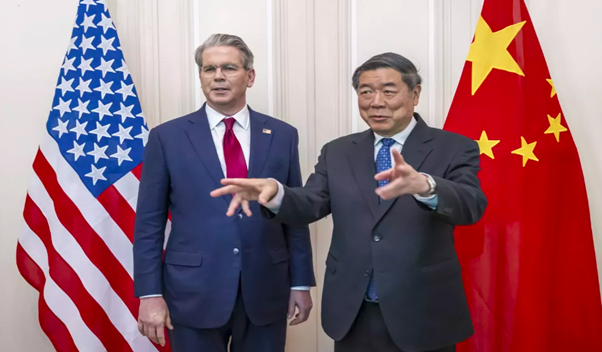
Both nations also agreed to set up a mechanism for ongoing discussions about their economic and trade relations, to be led by Chinese Vice Premier He Lifeng and U.S. Treasury Secretary Scott Bessent, along with U.S. Trade Representative Jamieson Greer. According to the joint statement, these discussions may take place alternately in China, the United States, or a third country, as mutually agreed by both parties. Additionally, the two sides may conduct working-level consultations on relevant economic and trade issues as needed.
A spokesperson for China’s Commerce Ministry called the joint statement “an important step by both sides to resolve differences through equal-footing dialogue and consultation, laying the groundwork and creating conditions for further bridging gaps and deepening cooperation[3].”
It’s an open secret that the trade war has significantly strained both economies, with the U.S. experiencing its first GDP contraction since early 2022 and China witnessing a sharp drop in exports. In response to its declining factory activity, China is taking assertive steps to roll out economic stimulus.
This shift in China’s tone is a powerful contrast to its earlier demands for the complete removal of U.S. tariffs before negotiations could commence. The breakthrough in talks, which was long overdue, signals a pivotal moment as previous discussions had primarily focused on merely reducing tensions rather than securing a comprehensive trade agreement.
Speaking at a Monday press conference in Geneva, Bessent said: “The consensus from both delegations is neither side wants to be decoupled, and what have occurred with these very high tariffs … was an equivalent of an embargo, and neither side wants that. We do want trade. We want more balance in trade. And I think both sides are committed to achieving that.3”
CCP Shameless Urban Legend
Chinese Communist Party controlled state media asserts that the government’s “resolute posture” has successfully led to an agreement to resolve the trade conflict with the United States. This significant move follows President Donald Trump’s aggressive tariff hikes, which were designed to tackle the staggering $300 billion U.S. trade deficit with China.
This deal unequivocally demonstrates China’s effective counter to what it deems U.S. “discriminatory measures” against its trade practices, according to Yuyuan Tantian, a social media account affiliated with the state broadcaster CCTV[4].
“This shows that China’s firm countermeasures and resolute posture had a strong impact, and that these actions indeed caused significant pressure on the U.S. side—leading the American government to lower tariffs back down to the base level,” Song Guoyou, executive director of the Asia-Pacific Cooperation and Governance Research Center at Shanghai’s Fudan University, was quoted as saying.
Hu Xijin, former editor of Chinese state tabloid Global Times, wrote on Weibo: “This is a huge victory for China’s firm adherence to the principles of equality and mutual respect [ …].”China reaching an equal-footing agreement with the U.S. is not only a win for China, but also a victory for international trade norms and the proper global order. This agreement sets an example and benchmark that could inspire other countries to assert them more confidently in defending their interests.4”
Also, Xi Jinping, Chinese president, told Latin American and Caribbean officials during a Beijing summit: “Tariff wars and trade wars produce no winners. Bullying and coercion only lead to isolation.4”
However, Global investors are reacting positively, as this development is poised to alleviate market disruptions and quell recession fears. Consequently, Dow futures surged more than 2%, S&P 500 futures jumped nearly 3%, and Nasdaq futures soared over 3.5% during Asian trading.
Meanwhile, Hong Kong’s Hang Seng index closed approximately 3% higher.
The U.S. dollar gained strength against other currencies, while gold prices dropped, reflecting growing investor confidence.
Dan Ives, a managing director at Wedbush Securities in New York, said the agreement to suspend most tariffs on each other’s goods was a “best case scenario” from the weekend talks. “This is clearly just the start of a broader and more comprehensive negotiations, and we would expect both these tariff numbers to move down markedly over the coming months as deal talks progress,” he wrote in a research note.
Source :- Getty Images
America’s Steak Path
It remains to be seen whether the Trump administration can meaningfully reduce the nearly $300 billion trade deficit with China, which has been a long-standing grievance for the president.
As Americans, we must recognize that maintaining a domestic supply chain is a strategic necessity. Restoring production to the U.S. is not just a priority; it is indispensable for our national security.
China’s support for North Korea, Iran and Russia and its disinformation campaigns cannot be ignored. The U.S. must adopt a consistent and clear policy approach toward China to establish predictability in U.S.-China bilateral relations.
The United States of America, the most technologically advanced nation on earth, must roll up its sleeves in competing with Communist China effectively while upholding American values, economic interests, and security, which is, of course, Para-Amount and non-negotiable.
The U.S. should also seize opportunities to collaborate with China on pressing health and climate issues, while staunchly promoting multilateralism and green energy initiatives.
It is imperative that the Trump Administration better define the objectives of strategic competition with China and achieve a balance between globalist and isolationist tendencies in America’s foreign policy.
On Domestic front, aggressively recruiting STEM graduates into government and defence roles is most crucial, alongside making significant investments in K–12 education to ensure a robust talent pipeline.
The U.S. should implement a national security education program for industries targeted by China and accelerate the adoption of zero-trust cybersecurity strategies. Strengthening public-private partnerships in cybersecurity is the need of hour, as is establishing international coalitions to combat cyber theft.
Additionally, keeping open channels for high-level negotiations on emerging threats is crucial to prevent conflict and navigate this complex geopolitical rivalry.
U.S. leaders must prioritize robust coordination with allies on economic and technology issues, particularly regarding investment restrictions and export controls. The ongoing securitization of trade relations with China under Trump administration and also to a very small extent under Biden administration has positioned the United States to negotiate from a place of strength and secure terms that favour ONLY American interests.
Rather than relying solely on tariffs, which have inhibited foreign investment in China and hurt our economy, the U.S. should capitalize on its strengths in the service sector to improve trade balances.
A firm approach that emphasizes soft power, alongside a clear policy of strategic ambiguity, is imperative. U.S. soft power must decisively compete with China’s influence, and there’s no obligation to match its investments dollar for dollar. The United States should strategically focus on key sectors and locations where it holds the greatest advantage.
We must promote dialogue that seeks peaceful resolutions while ensuring that our military presence and capabilities in the region remain credible and strong.
White House must also modernize our military capabilities and enhance cyber defences to bridge the military capability gap with China. Strengthening democratic institutions and actively engaging with social media stakeholders are critical to effectively countering AI-driven disinformation.
To counter the disruptive effects of emerging donors, the U.S. and its allies must proactively engage new donors within established frameworks.
To effectively deter China and preserve military dominance, America must strengthen regional alliances and deepen partnerships in the Indo-Pacific. A stronger military relationship with allies like the Philippines, Japan, South Korea, and Australia sends a clear message to China, deterring potential aggression.
Furthermore, allies must invest in robust defensive systems to prepare for any conflict scenarios. Improving security coordination and establishing solid crisis management channels with adversaries is essential.
In regard to Taiwan, the U.S. must take decisive action to bolster defenses while strategically managing diplomatic relations to avoid escalating tensions.
The United States should partner both economically and militarily with India, the largest democracy on earth, to tackle Chinese hooliganism both in the Indian Ocean and South China Sea where Indian Navy has a very big presence.
Time has come when America should stop giving any type of aid to Pakistan, breading ground of terrorism and must blacklist Pakistan on all international forums including Financial Action Task Force (FATF).
THE TIME FOR DECISIVE ACTION IS NOW OR NEVER.
[1] China Factory Protests Show When US Tariffs Began to Bite – Newsweek
[2] China PMI: Factories take a big blow as Trump’s tariffs bite | CNN Business
[3] China Pauses Sanctions on US Companies in Trade War Climbdown – Newsweek
[4] China’s State Media Claims Victory After US Trade Talks – Newsweek