Citizenship, Freedom, and the Work of a Representative Republic
Concannon Brief
May 23, 2026
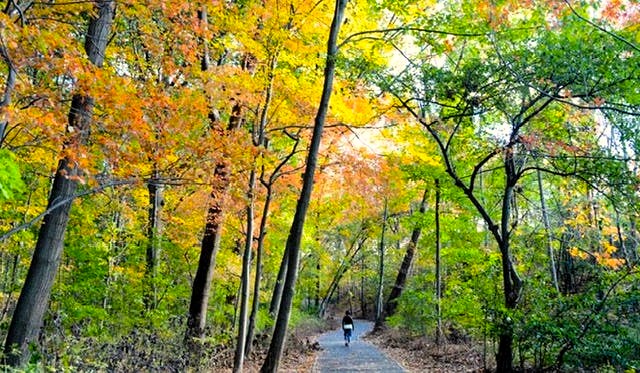
A Saturday in Cunningham Park became a reminder that freedom, citizenship, and self-government survive only when ordinary Americans choose to participate rather than withdraw.
This past weekend, I stood in Cunningham Park in Fresh Meadows, Queens, circulating a petition for a political candidate.
In about an hour and a half, I collected 30 signatures. On paper, that was a successful outing. But the more important story was not the number of signatures I collected. The more important story was the number of people I met who would not sign, could not sign, or had simply withdrawn from the political process.
Some people told me, “I don’t speak English.”
Others said they were green card holders.
Some were here on work visas.
Others said, “I don’t believe the government.”
One person said, “I’m tired of elected officials lying to me.”
Another said, “My vote doesn’t count.”
Those answers are not all the same. Some reflect legal barriers. Some reflect language barriers. Some reflect distrust. Some reflect exhaustion. Some reflect a belief that government is corrupt and that nothing can be done.
But taken together, they point to a serious civic problem:
Too many people are living in our communities while remaining outside the civic life of the country.
That should concern us.
Not because every person I met was eligible to vote. Some were not. Green card holders and visa holders may be lawful residents, workers, taxpayers, neighbors, parents, and contributors to the community. Still, they are not eligible to vote in New York unless and until they become United States citizens. New York voter registration rules require a person to be a U.S. citizen, meet age and residency requirements, and satisfy other eligibility standards. New York State Voter Registration Rules.
That legal boundary matters.
Citizenship matters.
But the most troubling conversations I had were not with people who were legally unable to vote. The most troubling conversations were with citizens who could vote but would not.
These were not people without opinions. They were not people without intelligence. They were not people without a stake in the future of New York City or America. Many were solid citizens. They work, pay taxes, raise families, use parks, ride subways, worry about public safety, schools, housing, inflation, immigration, and the future of the country.
But they are not engaged.
They are present in the community,
but absent from the process.
They are visible to the government when taxes are due, when regulations are enforced, when forms must be filed, and when services are needed. But they are invisible when decisions are made.
As I walked through Cunningham Park, I realized I was not simply hearing frustration. I was hearing how disconnected many people have become from the meaning of citizenship itself.
What Does It Mean To Be a Citizen?
What does it mean to be a citizen of the greatest nation on earth?
If citizenship is only a legal label, then perhaps it does not feel like much. A person has documents. A person has a passport. A person has the right to vote. A person may be called for jury duty. A person pays taxes.
But citizenship in America is supposed to mean more than that.
A resident lives under the law.
A citizen has a say in shaping the law.
A resident is affected by government.
A citizen has a role in correcting government.
A resident may complain about public officials.
A citizen has tools to hold public officials accountable.
The difference is not human worth.
Every human being has dignity.
A lawful permanent resident, a visa holder, a tourist, a new immigrant, and a citizen are all human beings deserving of basic respect under the law.
The difference is civic participation and civic responsibility.
Citizens carry a share of responsibility for the direction of the republic.
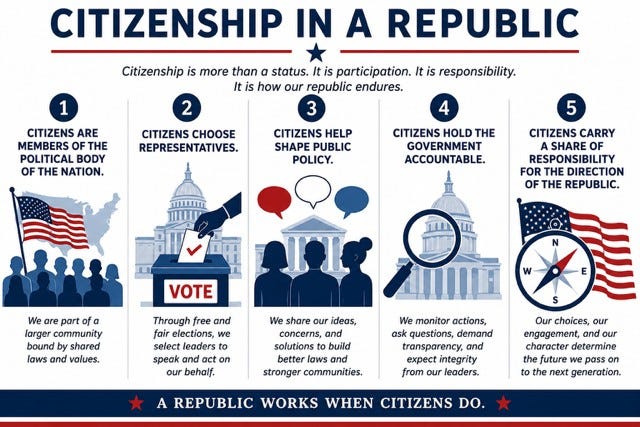
Citizens carry a share of responsibility for the direction of the republic.
That is what makes citizenship important.
Citizenship is stewardship.
It means receiving a free country, caring enough to participate in it, correcting it when necessary, and passing it on stronger than we found it.
A citizen is not merely governed by the republic.
A citizen is part of the people who make the republic work.
The Peaceful Tools of Citizenship
Citizenship is not merely a feeling or an opinion. In a representative republic, citizenship comes with peaceful tools that allow ordinary people to participate in self-government.
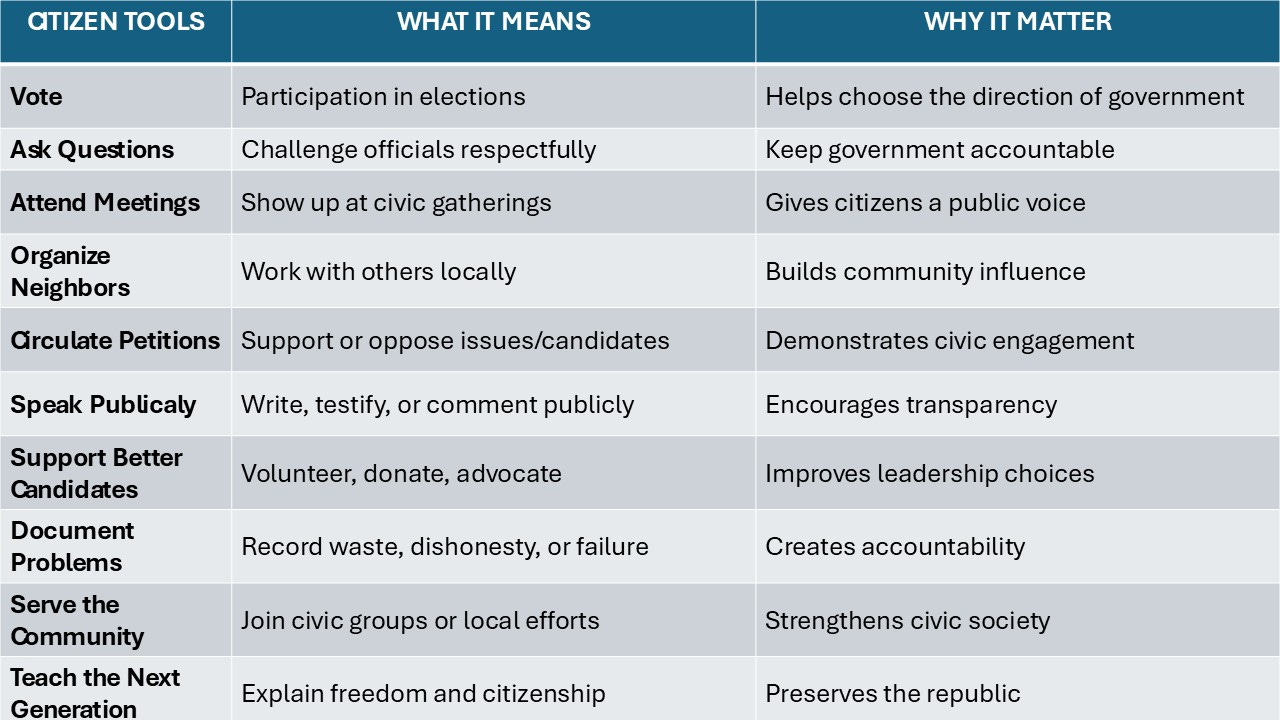
The peaceful tools of citizenship are the ordinary actions through which free
people participate in self-government and help preserve the republic.
These are the peaceful tools by which free people govern themselves.
A citizen is not powerless.
A citizen has tools.
Not violent tools.
Not destructive tools.
Lawful tools.
That is the difference between being ruled and participating in self-government.
You Are Not Invisible
Citizenship tells the individual something important:
You are not invisible.
You are not merely a number in a database.
You are not merely someone who pays taxes, follows regulations, and lives under laws created by others.
You are part of the civic life of the country.
Your voice matters.
Your participation matters.
Your absence matters too.
When citizens withdraw completely, government becomes more distant, less accountable, and more controlled by organized insiders and special interests.
That is why citizenship carries responsibility.
Not because every citizen must become a politician, but because free societies depend upon enough ordinary people remaining engaged.
Throughout history, free societies have weakened not only because of outside enemies, but because citizens gradually stopped participating in self-government.
Freedom is inherited, but citizenship must be practiced.
A Representative Republic
America is not a pure democracy where every citizen votes directly on every issue. We are a constitutional representative republic. The people are sovereign, but we govern through elected representatives, written laws, constitutional limits, courts, elections, public debate, civic associations, and the peaceful transfer of power.
In a representative republic, citizens choose representatives, monitor them, petition them, challenge them, replace them when necessary, and organize with other citizens to influence the direction of government.
That system only works when citizens participate.
A representative republic does not run on spectators.
It runs on citizens.
One of the rawest comments I heard in Cunningham Park was this:
“I’m tired of elected officials lying to me.”
That statement deserves respect. Many Americans feel that way. They believe promises are made during campaigns and forgotten after elections. They believe public officials say one thing and do another. They believe the government protects insiders and burdens ordinary people.
But in a representative republic, the answer to dishonest leadership is not withdrawal.
The answer is redress.
The First Amendment protects freedom of speech, freedom of the press, peaceful assembly, and the right “to petition the Government for a redress of grievances.” Read the First Amendment.
That phrase is not decorative language.
It is one of the essential tools of free citizens.
Complaint vs. Redress
Many citizens know how to complain about the government. Far fewer understand how to seek lawful and constructive redress.
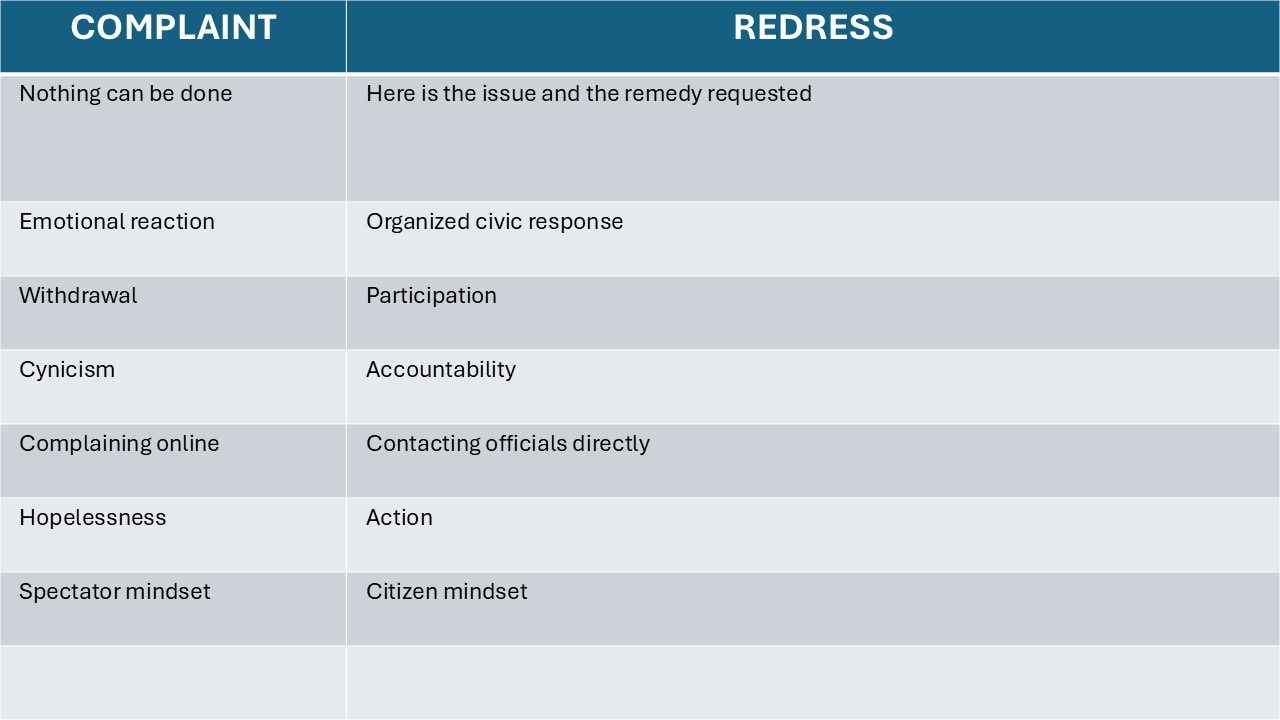
Free citizens do more than complain about the government. They use lawful and
constructive tools to seek accountability, correction, and redress.
A citizen can document dishonesty.
A citizen can compare promises to actions.
A citizen can contact elected officials.
A citizen can organize neighbors.
A citizen can attend meetings.
A citizen can support better candidates.
A citizen can vote in primaries and general elections.
That is how a free people corrects government.
Not perfectly.
Not instantly.
Not without frustration.
But lawfully, peacefully, and persistently.
The most dangerous civic sentence in America may be this:
“Nothing can be done.”
It sounds like wisdom, but often it is surrender.
Corruption grows when citizens stop watching.
Bad officials survive when citizens stop voting.
Political machines thrive when citizens stop organizing.
The answer is not blind trust in government.
The answer is disciplined citizenship.
Freedom and the American Dream
As Memorial Day approaches, I keep thinking about something deeper during my conversations in Cunningham Park.
Many people no longer fully recognize the extraordinary freedom they have inherited.
Some had lost faith in government.
Some believed their voice did not matter.
Some had withdrawn from civic life completely.
And yet millions of people around the world still want what America offers.
Freedom.
Not perfect politicians.
Not a perfect government.
Freedom.
The freedom to speak openly.
The freedom to worship openly.
The freedom to criticize leaders without fear.
The freedom to vote.
The freedom to organize.
The freedom to build a business.
The freedom to raise a family.
The freedom to pursue a better future.
Those freedoms are so familiar to many Americans that they can begin to feel ordinary.
But they are not ordinary.
Freedom is rare in human history.
The Declaration of Independence speaks of “life, liberty, and the pursuit of happiness.” Read the Declaration of Independence.
The American Dream is not a guarantee of wealth.
It is the opportunity to build a life through freedom, responsibility, work, faith, family, education, service, and self-government.
America promises opportunity, not perfection.
That promise has drawn millions of people to America from every corner of the world.
Not because America is flawless.
But because America offers something rare in human history: the ability of ordinary people to shape their own future.
Freedom survives when citizens value it enough to participate in protecting it.
Why Memorial Day Matters
That is why Memorial Day matters.
Memorial Day is not only about honoring the fallen.
It is about honoring what they died protecting.
Freedom.
Self-government.
The constitutional republic.
The idea that ordinary citizens should have a voice in the future of their country.
The ability of free people to govern themselves peacefully through law, elections, civic participation, accountability, and constitutional rights.
That inheritance was not handed to us without cost.
Americans fought and died for it.
This is why my Saturday in Cunningham Park mattered.
I was not merely collecting signatures. I was
participating in the ongoing work of
self-government.
One conversation.
One petition.
One citizen speaking to another citizen.
That may seem small.
But free nations survive through millions of small acts of citizenship practiced consistently over time.
That is how liberty is preserved.
What We Must Do Next
New York City offers a warning. In the 2023 city elections, turnout was extremely low despite high voter registration. NYC Campaign Finance Board Voter Analysis.
Low turnout does not mean people have no opinions.
It often means people have lost confidence that participation matters.
That is the problem we must address.
The answer is not simply more campaign mail, slogans, or anger on social media.
The answer begins with civic literacy and personal invitation.
People need to know:
- who represents them,
- how to register,
- how primaries work,
- how to contact officials,
- and how to participate constructively.
We should not approach discouraged citizens as if they are ignorant.
We should approach them as people whose trust must be earned back through truth, patience, and practical help.
I did not solve America’s civic problems in Cunningham Park that afternoon.
But I was reminded that citizenship still begins person to person.
One conversation at a time.
What You Can Do This Week
- Verify your voter registration.
- Learn who represents you locally.
- Read one founding document.
- Attend one civic meeting.
- Bring one younger person into a civic conversation.
- Thank a veteran or Gold Star family this Memorial Day.
- Explain to someone why freedom requires participation.
Civic Resources
- Register to Vote in New York
- Check Your New York Voter Registration Status
- Find Your Elected Officials
- Read the First Amendment
- Read the Declaration of Independence
- Learn About Memorial Day and Its Meaning
- NYC Votes Civic Information
- U.S. Citizenship and Naturalization Information
The conversations in Cunningham Park reminded me that freedom cannot survive on autopilot.
A representative republic depends upon citizens who are willing to participate, ask questions, hold officials accountable, organize peacefully, teach the next generation, and value the freedoms they inherited.
That is why Memorial Day matters.
Not only because Americans died.
But because they died protecting something worth preserving.
Freedom.
Citizenship.
Self-government.
The American Dream.
And the responsibility of ordinary citizens to keep all of it alive.
This Memorial Day weekend, perhaps the most important question is not whether America is perfect.
The question is whether we are willing to do the work required to keep a free republic alive.
Citizenship is stewardship.
It means receiving a free country, caring enough to participate in it, correcting it when necessary, and passing it on stronger than we found it.
Perhaps that work begins more often than we realize — sometimes with nothing more than a conversation in a park.
I’m on Substack: check it out and leave your thoughts