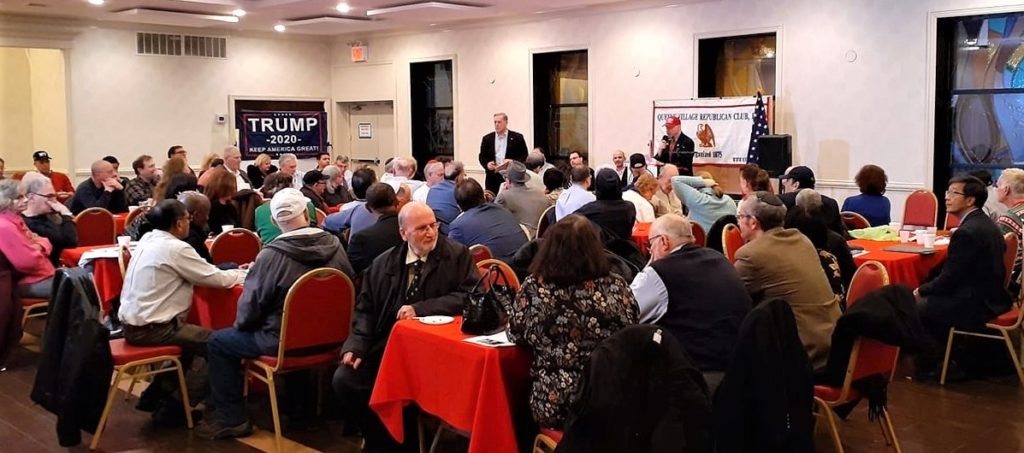
Our New Year’s Club Meeting on January 2nd was an exciting and well attended public event featuring three New York college professors who are spearheading the battle against the abuses of the left on college campuses. The meeting topic dealt with anti-American leftwing indoctrination and preserving free speech for all. Here are the videos of the inspiring presentation.
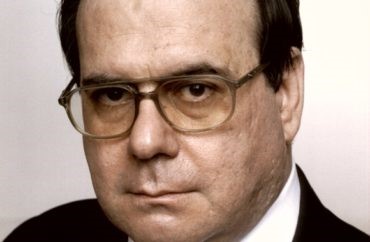
Mitchell Langbert is an Associate Professor of Business at Brooklyn College
Nicholas Giordano is a Professor of Political Science at Suffolk County Community College.
Bob Capano is an Adjunct Professor of Political Science at CUNY Colleges.
Installation of 2020 Club Officers and Board Members
This article by Mitchell Langbert, is an opinion piece in The College Fix, a higher-education news website of veteran journalists helping beginning journalists committed to the principles of a free society.
Professor Langbert will be speaking at the QVGOP New Years Club Meeting on Academic Freedom, a free event, open to the public, on Thursday Jan. 2nd. More information.
Editor’s note:Late last year, throngs of angry leftist students and social media warriors demanded that Mitchell Langbert, an associate professor of business at Brooklyn College, be fired for joking on his personal blog about the Brett Kavanaugh sexual assault allegations. Today his fall 2019 semester classes are overbooked and during the last 10 months he’s juggled several scholarly projects. The effort to ruin him failed. Here’s his story.
‘Indeed, you haven’t lived until you’ve been burned in effigy’
I spent my early life in left-wing neighborhoods in New York City and Woodstock, NY, but by the time I attended Sarah Lawrence College in 1973 I was questioning collectivism. I witnessed one corporate headquarters after another exit New York City because of high taxes and regulation. As well, Solzhenitsyn’s Gulag Archipelago opened my eyes to the blood-drenched shadows of socialism. In my twenties I read all I could about the Austrian economists and the Founding Fathers while I pursued a corporate career that ended because so many New York firms were moving to Atlanta.
So, after nine years in corporate America, I decided to get a Ph.D., but I realized that a career in academia, especially in the Northeast, required strict adherence to left-oriented ideology. Unfortunately, having landed a few academic jobs, I was unsuccessful at cloaking my views.
More recently, having read de Jouvenal’s On Power, I concluded that decentralization of federal power will be crucial to the rejuvenation of individual liberty. One concern is the living Constitution theory. Hence, the appointment of Justice Brett Kavanaugh last fall was a wonderful, miracle-on-ice moment, courtesy of President Trump. When the left and its media attacked Justice Kavanaugh, I made a joke about the allegations on my blog.
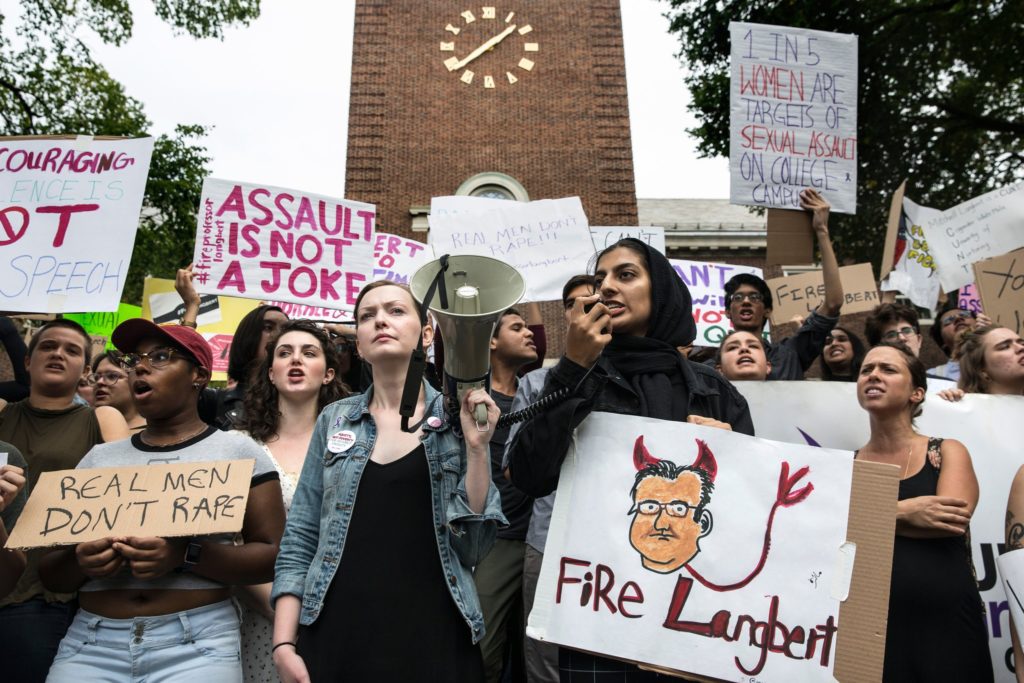
Someone was trolling my blog, and in response, there were campus protests. They also pounced while I was at the podium. The New York City-based newspapers (see here, here, here and here) joined in. I had been receiving publicity for work I had been doing on the absence of Republicans from higher education, but the intense media interest was a surprise. I received about 200 hate emails, including several threats. These were paradoxical because the writers were outraged that I had made light of the Kavanaugh sexual assault allegations, so they threatened me with sexual assault. One leftist named Carol D wrote: “Sir, I relish the thought of a gang of boys becoming men at your assholes expense. History will pull back your lizard skin and your pathetic attempt at being relevant will be exposed as nothing more than a losers fame grab.” The left-wing concern about words that harm is evident in Carol D’s work.
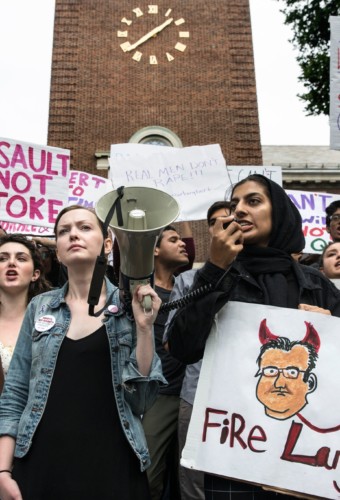
Protesters at Brooklyn College on Thursday demanded that Mitchell Langbert, an associate professor of business, be fired for his blog post about sexual assault. Photo credit: Holly Pickett for The New York Times
My initial response to the media phone calls and left-wing hate speech was, of course, stress, as well as some fear that I might lose my job. Within a few days, these were alleviated by the Foundation for Individual Rights in Education, which told me that not only do public employees have First Amendment protection but also that any contact from the college, such as an investigation, would justify First Amendment litigation. As well, I was referred to an attorney who told me that I should retain his firm only if the college administration broke the no-contact rule, which it didn’t. There were a couple of additional protections that frustrated protesters: First, the City University of New York has an academic freedom provision in its bylaws. Second, I have academic tenure.
One of the distortions in the media coverage was the implication that a large number of students supported the protests. In fact, only a couple of hundred out of 18,000 students at the college participated in the protests. About two or three percent of the college’s student-and-faculty body signed an online petition to have me fired. The other 97 percent did not spend a minute on the question. Many students were on my side, but because CUNY’s left-wing administration suppresses conservatives, these students were silent.
In thinking about how to respond to authoritarian attacks, practical concerns are important. The best defense against suppression is private resources. Back in the 1970s I knew a couple who had worked at the U.N. but was fired from the U.S. Embassy during the McCarthy era. They took their resources and founded a retail store that built on their international connections. Since I am close to retirement, I was not worried financially. Dissenters in an authoritarian climate need to strategize how to accumulate resources that enable them to remain independent.
I made one major gaffe: an apology. When I wrote the blog, I meant it as humor. A friend convinced me to write that I had meant the blog to be satirical in the tradition of Jonathan Swift’s “A Modest Proposal.” I later discussed this with a libertarian economist who had been attacked in the Las Vegas newspapers, and he agreed that one should never apologize. Apologies give the pro-Antifa media an additional wedge. (See this.) When the mainstream media attacked Stephen Moore in the context of his Fed appointment, he kept apologizing, and I wish he hadn’t.
Survive the attack I did. Within six months a Wall Street Journal editorial cited my work; a Texas public policy foundation hired me to do a study of a back-to-work training program; I continued to work on a project with friends at Heterodox Academy and the University of Maryland; Lou Dobbs of Fox Business put my name on the TV screen when discussing one of my articles on faculty political affiliation; and the National Association of Scholars, for whom I have written in the past, asked me to write an essay about the student protests at Sarah Lawrence College. As well, the Glazov Gang asked me to do a series of podcasts (and here and here), which have each gotten a couple of thousand hits. My classes have filled to the brim for the past two semesters, and this fall semester my courses are overbooked with waiting lists.
There were, of course, some adverse reactions as well. A young representative of a famous conservative foundation said that he did not want to work with me anymore, and a couple of people I had worked with or corresponded with in the past became cool. On the other hand, one of my friends, a well-known Austrian economist, was envious that the students had lumped me in with Kavanaugh and Trump in the protest. Indeed, you haven’t lived until you’ve been burned in effigy. On balance, the event enabled me to separate the cowardly chaff in my network from the imaginative wheat.
Having gone through the experience unscathed and better off, I am concerned that many others who have been outed by the left-wing, authoritarian mob lack defenses. My case is exceptional because of my public university, First Amendment, and tenure protections.
I have contacted a number of leading conservatives and suggested that steps be taken to organize a support-and-activist group. Such a group could include a response group that might overwhelm media and corporate Antifa sympathizers with protest emails as well as an advisory group that could provide guidance to victims. So far, I have heard nothing back. Unfortunately, conservative and libertarian leaders continue to suffer from a political wimpiness that ensures failure. Ultimately, we need to ask whether the moral compass of a media based in New York City is of value or relevance.
Mitchell Langbert is associate professor at Brooklyn College. He lives in West Shokan, New York.
The Queens Village
Republican Club stands with people of all faiths, but now at a time of rampant
anti-Semitic attacks, we stand up in outrage and stand up for justice with the
2 million people of Jewish faith in New York State. Violent anti-Semitic
attacks were committed by perpetrators who were released without bail even
before the new bail reform law kicks in on January 1, 2020. Last night, at a
celebration of the seventh night of Chanukah, we witnessed a bloody
anti-Semitic attack at the home of Rabbi Chaim Rottenberg
in Monsey, NY where 5 people were severely wounded. Recently we witnessed
at least 13 vicious anti-Semitic attacks in New York State and many more on
college campuses across the country.
The recent wave of criminal justice activism has gone way too far! Our club is
outraged as we are witnessing the breakdown of law and order due to the
feckless policies of the Democrats running a one-party government in our city
and state. The outcome of Democrat Party rule is that New York City and New
York State are going in the wrong direction. We see the consequences of
bail reform, and radical leftist policies calling for closing Rikers,
freeing 1000’s of inmates, defying ICE, and even abolishing our
police force, where criminals are emboldened to commit atrocious
anti-Semitic acts with impunity and are released without bail.
The left is mobilized and organized, and they have taken every
Democrat elected official hostage. We believe the only way to fight back is to
organize, recruit and register Republicans! We need a strong organization of
Republican county committee activists who can get out the vote to elect
Republicans who can make policy changes in our government that effect our
everyday life. We must turn the tide!
This is the time to act, and we will do so. We ask all our club members and
friends to stand with us and the Jewish people of New York!
THURS. JAN. 2, 2020 at 7:30 PM At: Young Israel of Holliswood – Holliswood Jewish Center 86-25 Francis Lewis Blvd., Holliswood, NY 11427 CLICK HERE FOR MORE INFO
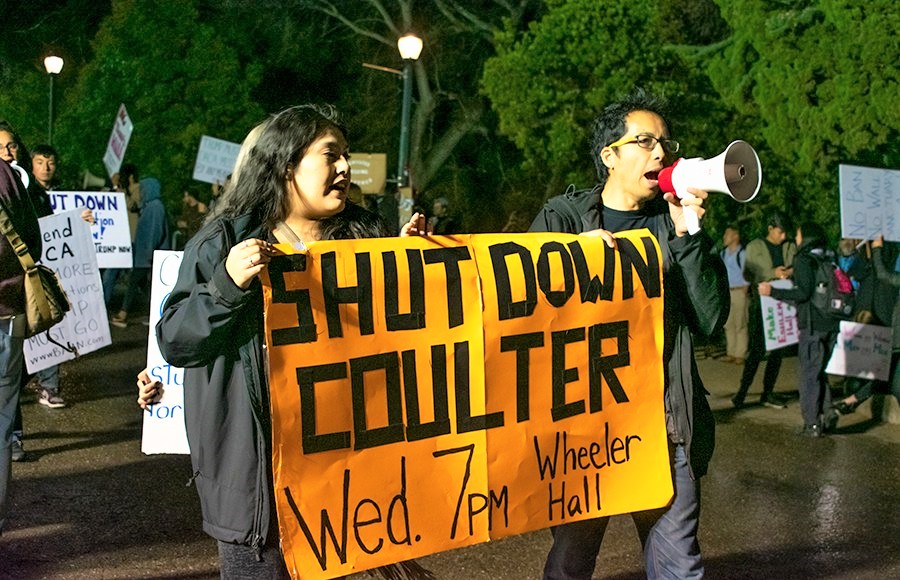
A speech by Ann Coulter at University of California, Berkeley drew more than a thousand protesters. Photo Credit: The Daily Californian/Daniela Cervantes/Senior Staff
Our college campuses are out of
control. They’ve become hotbeds of anti-American indoctrination. It’s time for
Republicans to get involved in our school systems from top to bottom.
Years ago, our colleges and
universities were noble institutions dedicated to truth-seeking and transmitting
our cherished heritage from the classical Greek, Roman and Judeo-Christian roots of our Western Civilization.
Today these same institutions are offering courses with such titles as
“Dismantling White Privilege, Power, and Supremacy,” “Marx for Today”
and “Queering God: Feminist and Queer Theology,” with no tolerance for
differing political views. Many have
become intolerant ideological centers of “Cultural Marxism,” penalizing any
speech deemed offensive or deviating from the politically correct dogma.
The “cancel culture” is now dominant on
college campuses. In November, a 200-strong leftist student mob at Binghamton
University violently attacked a small group of College Republican students
handing out literature promoting an upcoming lecture by well-known economist
Art Laffer. They destroyed the tables and physically threatened the Republican
students for expressing their political views and support for Israel. The
rioting student radicals later prevented Laffer from speaking, cancelling the
lecture before he could utter a word. They believe they have a right to use
physical violence to stamp out what they consider offensive opinions. A Yale
study reveals that 31% of college students believe it’s OK to use violence to
stop “hate speech” or “racially charged language.”
Violent protests have stopped Ben
Shapiro, Milo Yiannopoulos, Jordan Peterson and many other conservative campus
speakers. Ann Coulter was invited to speak at Berkeley, ironically known as the
“birthplace of the free speech movement.” But her speech was suddenly cancelled
when leftist student mobs decided to riot. Yet, the bloody Iranian dictator
Mahmoud Ahmadinejad was welcomed with open arms at Columbia University, and a
dean at Columbia said he would gladly welcome Adolf Hitler to speak on campus.
Recently Bucknell University invited and applauded an Antifa leader who
promotes political violence against conservatives to speak on campus, while a
professor called President Trump a “White Supremacist” and his election an “act
of terrorism.”
This is nothing new. It’s
the outcome of the long march of the left into our cultural and academic
institutions. In the 1960s, when student radicals and leftists failed in their
attempted revolution in the streets to overthrow America, they marched into our
schools and colleges to become teachers, professors and administrators. It was
part of a carefully planned non-violent agenda to topple our nation by a
cultural revolution to control the minds and radicalize our children.
Nelson Mandela said it best: “Education is the most powerful
weapon which you can use to change the world.” Former FBI agent, Cleon
Skousen testified before Congress in 1963 on the goals of Communists infiltrating
our nation: “Get control of the schools. Use them as transmission belts for
socialism and current Communist propaganda. Soften the curriculum. Get control
of teachers’ associations. Put the party line in textbooks.”
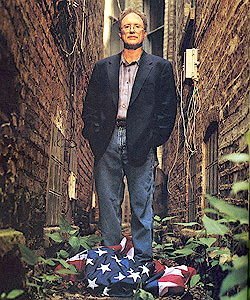
Unrepentant anti-American and former terrorist Bill Ayers
A leading
figure in the revolution from the streets to the schools, was Bill Ayers,
leader of the Weather Underground, a 1960s domestic terrorist group. He
participated in bombing government buildings throughout the country, including
the Pentagon and the Capitol. “Kill all the rich people. … Bring the
revolution home. Kill your parents” were his words of wisdom.
This unrepentant domestic
terrorist, who never taught in a classroom, became a distinguished professor of
education at the University of Illinois. Today teachers throughout America
indoctrinate our children using his radical program of education for social
justice, teaching that America is racist, oppressive and evil and that
socialism is the solution.
This is a call to action. Republicans
and Conservatives, and all honest citizens who love America need to get
involved in our education system. We can follow the lead of our great President
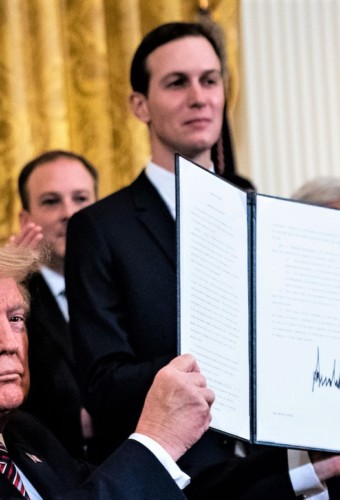
Trump, who recently signed an historic executive order to battle anti-Semitism
on college campuses. This executive order protects Jewish students from bigotry
and discrimination by making Title VI of the 1964 Civil Rights Act apply to
anti-Semitic acts, withholding federal tax dollars from academic institutions
that won’t combat this growing hatred. Harvard Law Professor Alan Dershowitz said
there has been “no more important event … to turn universities away from
being bastions of hatred and discrimination than this executive
order.…it will go down in history as one of the most important events in
the 2,000-year battle against anti-Semitism.”
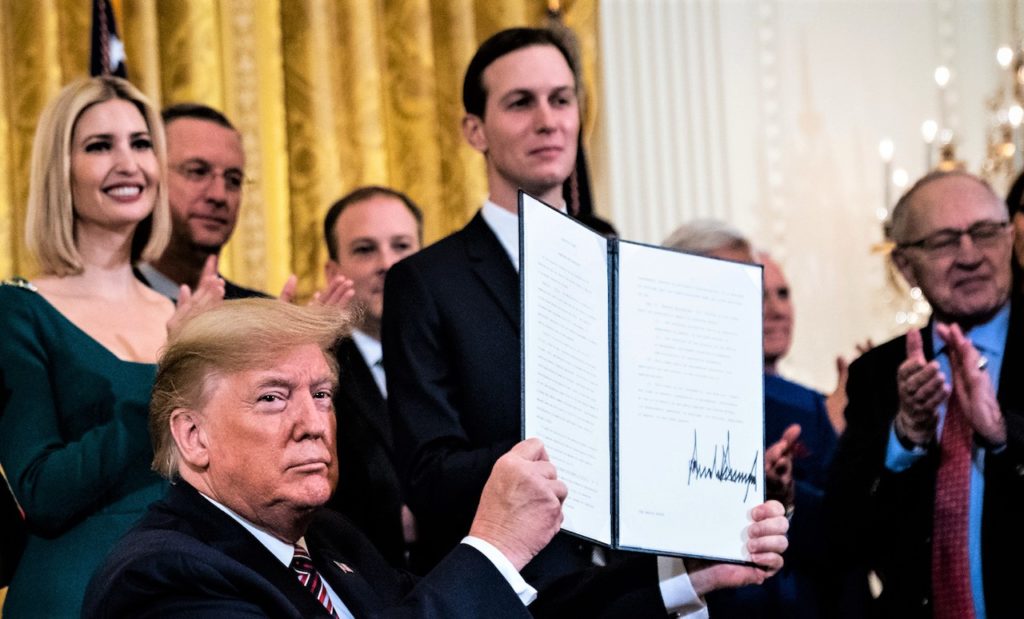
President Trump displays Executive Order on Combating Anti-Semitism after signing it on Dec. 11. At right is Law Professor Alan Dershowitz.
There is a great deal that Republicans
can do to follow in the footsteps of our president to cut federal and state
funding for schools that refuse to protect the freedom of speech rights of
students and faculty, or refuse to take action against violent offenders on
campus. Our education system is rotten to the core and reforming it should be
the number one priority for all Republican candidates running for elected
office. We Republican voters need to
mobilize our ranks, build our county committees in every AD, and get out the
vote in 2020 for our President Trump and any Republican who champions this
issue!
Our January 2nd Club meeting
will feature several New York City college professors who are spearheading the
battle against the abuses of the left on their respective campuses. Come, bring
your friends, especially students and faculty, to hear their proud stories of
how they are fighting back! We all need to get involved in order to save our
country and defend our civilization for future generations. Our long march back
into our colleges and universities has begun. Nothing can stop us now!