Phil Orenstein

Author Archives

What? Me Tweet? Why not!

What? Me Tweet? Why not!

By Sgt. Eric Spinner

We have all heard the constant vitriol against President Donald Trump for his presence on Twitter. Opinions run the gamut from positive to negative, but we can easily understand why he uses it- and to great advantage. We need to adopt it as a tool for our purposes, as well, or be overwhelmed by the opposition.

Donald Trump fully understands the social media and how it provides a platform that will allow one to speak  their  mind  without having  censoring  of   their   words   or   any chance  of  fake  news  altering  the  words. Because everything is in black and white, the evidence is always available to prove exactly what was said.
 
Another great advantage to using Twitter is that it forces one to think in simple, concrete terms. With a limit of just 200 characters in a Tweet, messages are quite brief and quickly read. Twitter users are not willing to spend the time to sit and read lengthy messages and will not dwell on something that looks lengthy or complex.  One does, however, have the ability to add links to online information, messages, or even other web-based locations. All one needs it the link to the material.
 
There are ways to direct messages to specific people, and a search function to find them. There are hashtag (#) items that can be inserted in messages to relate the tweet to a specific topic. You can follow other Tweeters at will so that their postings will be announced when you login to your account.
 
Another great feature of Twitter is that your ID, or handle, does not have to be your real name. When you sign up for an account, you give your name and email, but you can choose a handle that is more aligned with your mission and your message.
 
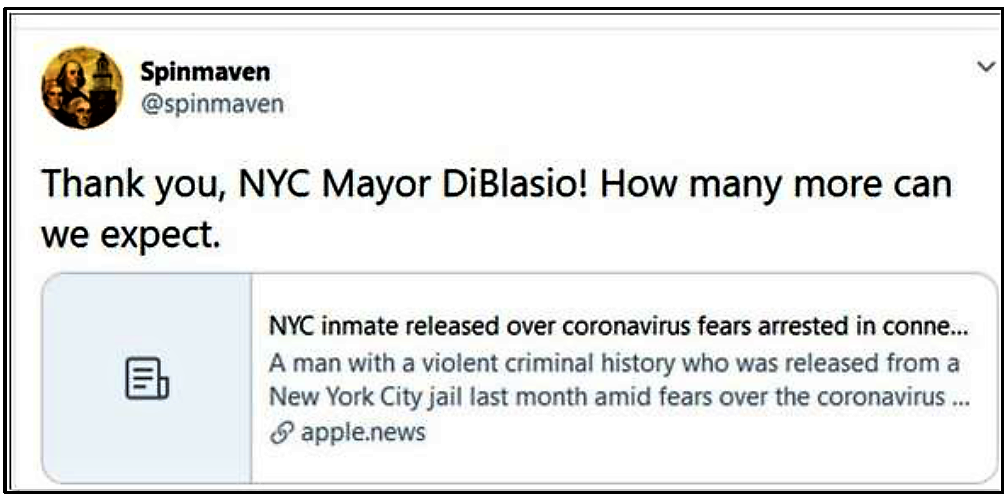
Those who have used or at least visited Twitter before should recognize what a tweet looks like. One of my recent tweets is pictured below. My logo and my handle appear in the upper-left corner, and my twitter address, @spinmaven, appears below it. Following that is my comment regarding Mayor DiBlasio’s release of Rikers Island inmates during the Covid crisis into the community. We all knew, of course, what the result of this foolhardy act would be, but of course also expected the results of this action. Having already had to deal with Governor Cuomo’s bail reform and DiBlasio’s sanctuary city policies, we knew that this could only result in more problems, and the linked item in the tweet certainly explains that at another location on the web.


Now we come to the specific purpose of this message. We are in the fight of our lives to preserve the Constitution of The United States of America, the supreme law of the land, against the constant assaults by the progressive left. If we are to get our words out there to be heard, we need to employ the social media. We cannot sit back and be silent- my mind wanders back to the Vietnam era with talk of the silent majority. We can be silent no more!

Cap that with the fact that there are so many issues we must deal with if we are to succeed. The left has used social media to their advantage. It’s time for us to wake up and use it to our advantage. Sure, we all love facebook, but all we are doing is sharing with our limited group of friends, and unless we go out on a limb, we don’t get very much pushback. Linked-In is for business use, and is not effective for influencing people. But Twitter is the way to go, and asking a simple, thoughtful question, under the right conditions, can start a thought or idea on a journey across the nation. Join us on Twitter! We must do this!

HISTORICAL TIMELINE OF CHINA

HISTORICAL TIMELINE OF CHINA

In order to understand the historical background of China and how they have become America’s number one threat, we present this brief historical timeline. It is very important to review and study this timeline in preparation for the Queens Village Republican Club’s May 7th Zoom meeting on the threat of China with Gordon Chang.  Historian, Jerry Matacotta was the main source and advisor for this timeline of Chinese history in the modern era. Relevant quotes were also selected from Bully of Asia by Steven Mosher.
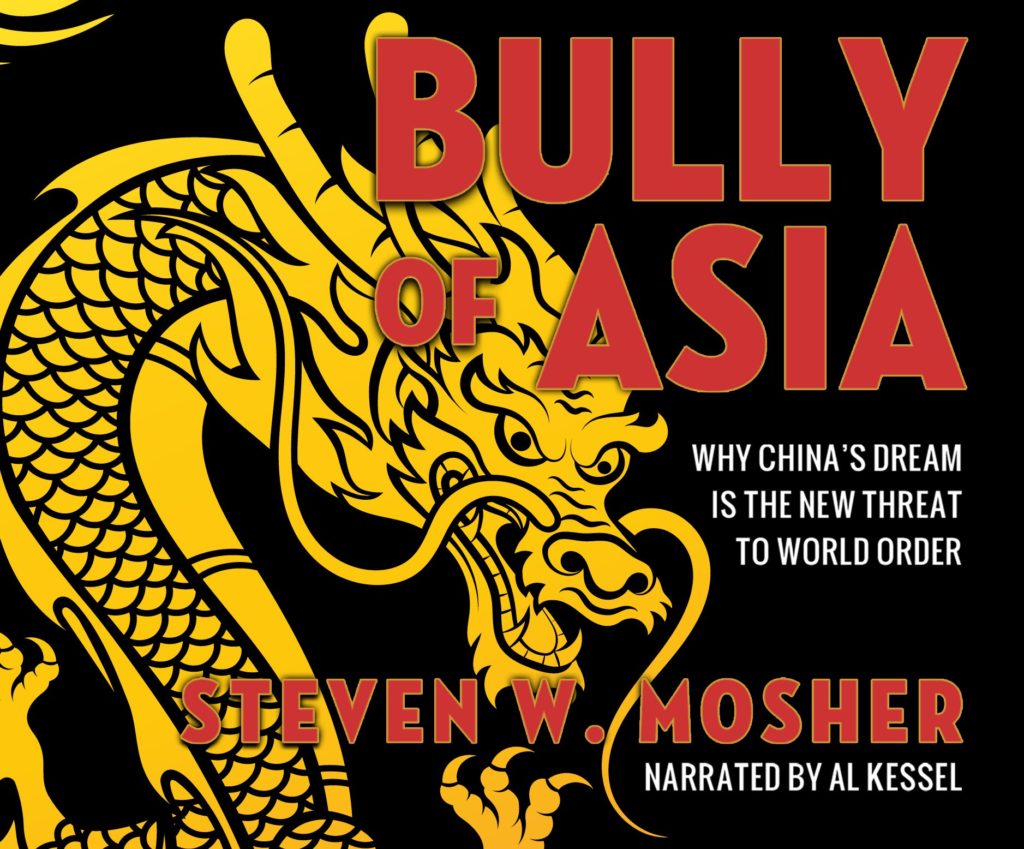
For more than 2000 years, the Chinese considered themselves the geographical and geopolitical center of the world… They believed their emperor to be the only legitimate political authority and regarded themselves as the highest expression of civilized humanity.    -Steven Mosher, Bully of Asia, p. 10

In all the world there is only one threat to the United States that must be classified as a disease of the heart. This is a country that long ago invented totalitarianism – the total subjugation of the individual to the state – and that still practices a modified form of this all-embracing political tyranny today.   -Steven Mosher, Bully of Asia, p. 6 

1839-1860 – Opium Wars. Two armed conflicts in China between the forces of Western countries and the Qing dynasty, which ruled China. Western powers were victorious and British won control of the opium trade in China and acquired Hong Kong. China became the weakest country in the world and resented any foreign influence. The major reason for China’s resentment of foreigners can be traced back to the Opium Wars, which became their rallying cry for nationalism.

The Opium Wars “… shook the empire to its core. The so-called “unequal treaties” that followed reduced China to a semi-colony of the Western powers. Western troops garrisoned China’s “treaty ports” – essentially, European colonies – and Western gunboats roamed its rivers.”   -Steven Mosher, Bully of Asia, p. 16

1900 – Boxer Rebellion – Uprising of Chinese nationals against foreign influence in China. After several months of growing violence and murder against foreign and Christian presence in June 1900, Boxer fighters (Chinese martial artists), convinced they were invulnerable to foreign weapons, converged on Beijing with the slogan “Support the Qing government and exterminate the foreigners.” They were defeated by Japan, Germany, United States and other Western powers which sent troops to crush the rebellion.

“Non-Chinese have difficulty appreciating the depth of China’s grievances against the West and Japan resulting from these experiences. It was not merely that Western gunboats had twice defeated China in the Opium Wars; China had been defeated before, although never perhaps by organized drug runners. Nor was the bitterness caused simply by the dethronement of Confucian high culture by the West…. The underlying problem was this: China had dominated (in every sense – culturally, economically, militarily) its known world almost since the beginning of its recorded history. More than what is today called a superpower, it had been the hegemon for century after century, dynasty after dynasty, for over 2000 years. Then within the span of a few decades, it was cast down from this pinnacle of greatness by the Western powers and Japan and brought low, divided into spheres of influence, and partially carved up into colonies.”     -Steven Mosher, Bully of Asia, p. 18

1912-1928 – After over two thousand years of imperial rule, the Republic of China was established in 1912 to replace the monarchy, in an attempt to bring some form of democracy to China. Sun Yat-sen served as the first president of the Republic of China and the first leader of the Nationalist Party of China. But China was chaotic, the Nationalist government was weak, and warlords controlled China.
1921-1927 – The Communist Party of China (CPC or CCP) was founded in 1921. The CCP grew quickly, and by 1949 it had driven the Nationalist government from mainland China, leading to the establishment of the People’s Republic of China (PRC) in 1949. In 1920 until 1927 the CCP worked together with the Nationalist government to get rid of the warlords and build a powerful central government.

1926-1928 – Chiang Kai-shek, follower of Sun Yat-sen, became leader of the Republic of China in 1928. He led the Northern Expedition campaign of the Chinese Nationalist army allied with the Communists, defeating a coalition of warlords, ending their control of China, and reunifying China under a new Nationalist government of the Republic of China.

1927 – Midway through the Northern Expedition, the alliance broke down and Chiang Kai-shek purged the Communists inside the party. Although the Communists welcomed Chiang, he turned on them, killing 1,000’s. In response, the CCP founded the “Red Army”, to battle Chiang’s Nationalist Party army beginning the Chinese Civil War. Mao Zedong was appointed commander-in-chief of the Red Army.

1931 – The Empire of Japan invaded Manchuria, took over and established a puppet state, while China was involved in civil war.  Chiang Kai-shek avoided a war with Japan in order to focus on defeating the Communists first.

“The political leader with the most experience fighting the CCP – first successfully and later much less so – was Nationalist leader Chiang Kai-shek. After the Japanese invasion of Manchuria in 1931, Chiang was under enormous pressure to declare war on the Empire of the Rising Sun. He refused, arguing that before the Japanese could be driven out of China, the Communist rebellion must first be put down. ‘First internal pacification, then external resistance,” he insisted…. Chiang stated: “The Japanese are like a disease of the skin, but the Communists are like a disease of the heart.”    -Steven Mosher, Bully of Asia, p. 1 

1934-1935 – Chiang Kai-shek’s Nationalist Party army defeated the Communists who begin a big retreat. Mao took the Red Army on the “Long March” into the mountains of Northern and Western China and consolidated his leadership as the head of the CCP. The Long March, the central event in Chinese revolutionary mythology, became the precursor of everything the CCP is today, and established Marxist–Leninism and Mao Zedong Thought (Maoism) as the Party’s guiding ideologies.
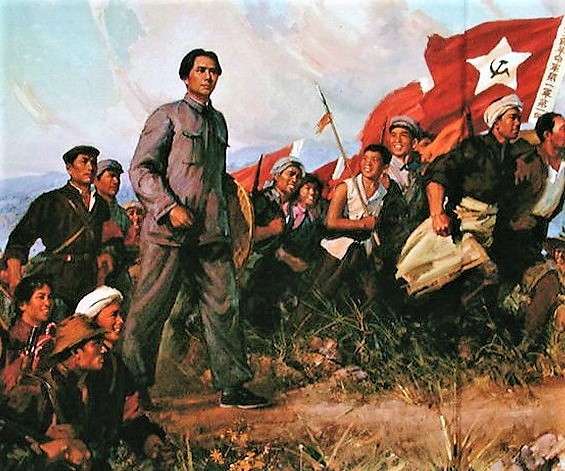
“The Long March is a manifesto. It has proclaimed to the world that the Red Army is an army of heroes, while the imperialists and their running dogs, Chiang Kai-shek and his like, are impotent. It has proclaimed their utter failure to encircle, pursue, obstruct and intercept us. The Long March is also a propaganda force. It has announced to some 200 million people in eleven provinces that the road of the Red Army is their only road to liberation.”   – Mao Zedong, On Tactics against Japanese Imperialism (December 27, 1935)  

1937 – Full-scale Japanese invasion of China. The Japanese scored major victories, capturing Beijing, Shanghai and the Chinese capital of Nanking in 1937, which resulted in the Rape of Nanking, which was an episode of mass murder and mass rape committed by Imperial Japanese troops against the residents of Nanking. That is why China despises the Japanese and any allies of Japan.

1939-1945 – Chiang Kai-shek and Mao made a temporary peace to form a united front of the Nationalists and Communists to fight against Japan.  

1945 – Yalta Conference was the meeting of the heads of government of the three World War II allies, United States, United Kingdom, and Soviet Union. The Soviet Union pledged to fight Japan and attacked the Japanese in Manchuria. Soviet Union, Nationalists and Communists were all fighting the Japanese in Manchuria.

1945-1949 – After surrender of Japan, ending WW II, Mao turned on Chiang Kai-shek and the Chinese Civil War resumed. The power of the Communist Party grew considerably with skillful organization and propaganda envisioning the Red Army conducting guerrilla warfare in defense of the people. The Soviet Union supported the Red Army from Manchuria with their own weapons and tanks, and military supplies captured from the Japanese. The Nationalist forces were weak, and the war concluded with Communist victory in mainland China. Chiang Kai-shek and two million Nationalist soldiers retreated to the island of Taiwan, and Chiang set up the Republic of China. America protected Chiang Kai-shek, and the containment policy against potential Communist advance began.

1949 – Mao Zedong proclaimed the founding of the People’s Republic of China (PRC) and did not recognize Taiwan, treated them as a rebellious group. Mao took over every aspect of Chinese life. All economic and cultural activity, schools, military, re-education of all the people to the communist system were all controlled by the PRC. Land reform campaigns forcibly seized land from landlords and redistributed it among peasants, who were encouraged to overthrow and kill landlords. The campaign to consolidate the power of the CCP continued, suppressing counterrevolutionaries, with mass trials and murder of millions of Nationalist supporters, businessmen and intellectuals.

1950-1953 – The Korean War was a war between North Korea and South Korea. PRC supporting the North, fought the USA supporting the South. The war ended in a stand-off creating the Korean Demilitarized Zone (DMZ) to separate North and South Korea.

1958-1962 – Great Leap Forward was the PRC’s economic and social campaign. Chairman Mao Zedong launched the campaign to reconstruct the country from an agrarian economy into an industrial society through the formation of people’s communes. But the cost was nearly 100 million deaths from man-made famine and mass executions, since private farming was prohibited, and people were moved from farming to industrial production; thus people starved.
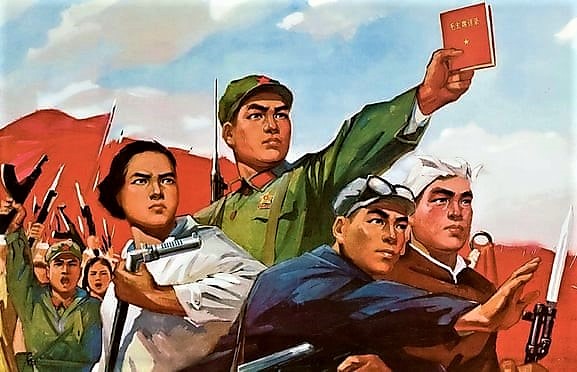
1966-1976 – The Cultural Revolution, was a decade-long period of political and social chaos, launched by Mao Zedong, turning against his own Party, to purge the Communist Party of “bad thought,” i.e. capitalism and traditional Chinese culture, and re-impose Maoism as the dominant ideology in the CCP and China. Kids tuned on parents, students turned on teachers and friends on friends for not following the Little Red Book of Mao’s sacred thoughts. Mao’s way was the only thought. The Red Guards, a mass student-led paramilitary social movement, heeded Mao’s call to burn and destroy cultural artifacts, Chinese literature, paintings, religious symbols and temples.

1972 – President Richard Nixon visited the People’s Republic of China, where he met with Chairman Mao Zedong and Chinese Premier Zhou Enlai. This historical visit opened China to the rest of the world for trade. We opened American markets and welcomed Chinese products into the United States. We witnessed the rise of China, as they industrialized, learned Western technologies, copied the West, and quickly became an industrial superpower, without changing their foundation in communist political ideology. Statism is the economic system of China, corporations run by the CCP, state-run industries.

1990-today – Business leaders and the Communist Party have joined together to became one entity in order to unite economic and political power for the benefit of the elite class, not for the people. Globalist elites of America are tied in with the elites of China. The Clintons, Biden, Bloomberg, Bill Gates, Steve Jobs, Mark Zuckerberg, and there are many other examples of globalists including McKinsey & Company, whose former senior partner Peter Walker was recently exposed on Tucker Carlson fawning over China. The globalist media as well, NYT, Washington Post, MSNBC, CNN, ABC News, Newsweek, and all the others; these Western globalist elites hate the West. They hate America. They foresee a one-world order run by technocrats, without freedom or democracy. They see China’s rise to dominate the West as a positive thing, so they can build up their own bottom lines. They see China as a friend and America as the enemy. They are all anti-Trump because Trump is anti-globalist and he is standing up against the threat of China’s economic and political domination. 

President Clinton gave China most-favored-nation status, starting free trade with China. He brought them in as global players in the world economy, pushed Congress for their entry into the WTO, made favorable trade deals, and moved US manufacturing to China, including American aerospace, nuclear, missile, and military technology, and pushed to open up the U.S. industrial base to Chinese offshoring. Presidents Bush and Obama continued these favorable China policies, to foster our nearly total dependence on Chinese manufacturing. President Trump was the first president to stand up to the threat of China and to stop their outrageous “theft of intellectual property,” “illegal dumping,” and “devastating currency manipulation.”

“China is already at war with us in the economic sphere. It consistently flouts the rules and breaks its promises. Its goal is to outstrip the United States, and it is not averse to undermining the existing international economic and political order to do so.”  -Steven Mosher, Bully of Asia, p. 240

“Few Americans have yet grasped either the depth of China’s historic grievance against the West or its vengeful envy of the United States in particular, or the breadth of its resurgent imperial ambitions. China is not just an emerging superpower with a grudge, though that would be worrisome enough. It is the hegemon, waiting to reclaim its rightful position as the center of the world.”  -Steven Mosher, Bully of Asia, p. 32

“Only the Chinese people, by overthrowing the current Communist dynasty in favor of democratic rule, can … diminish its relentless drive for domination.”  -Steven Mosher, Bully of Asia, p. 291


Call NYC Elected Officials on Question of Testing and Tracing Shadow Populations

CALL YOUR LOCAL ELECTED OFFICIALS!!

FIGHT BACK!! 
WE THE PEOPLE WANT ANSWERS!!

**** Read Open Letter to NYC Elected Officials below ****

CALL, WRITE, AND EMAIL YOUR REPS. 
ASK: WHAT IS THE PLAN TO TEST AND TRACE THE MORE THAN ONE MILLION PEOPLE LIVING IN THE SHADOWS IN NYC?
ASK THESE QUESTIONS:

ASK YOUR STATE ELECTEDS: How is mass testing and contact tracing going to be done by May 15 according to the Governor’s blueprint, so NYC can come safely out of lockdown, when large swaths of the city’s population are unaccountable, undocumented, homeless, and living in the shadows?

ASK YOUR CITY ELECTEDS: What is the city’s plan to identify, test, trace and quarantine those who test positive, from NYC’s most virus-prone populations of over one million illegal immigrants, homeless, and inmates recently released from city jails?

Find your New York State Assembly member here
Find your New York State Senator here.
Find you New York City Council Member here

We the people have to rise up and hold our elected officials accountable for a solution to the question of testing, tracing and quarantining the shadow populations of NYC!!!

It was their progressive policies that welcomed them here to our city and created this colossal  mess!!


Open Letter to NYC Elected Officials on Question of Testing and Tracing Shadow Populations From the Queens Village Republican Club. 

www.QVGOP.org
April 27, 2020
CONTACT: Joe Concannon
PHONE: 347-946-1931

EMAIL: INFO@qvgop.org

Governor Cuomo announced that New York will be on lockdown until May 15 in order to diminish the spread of the deadly virus and to insure there will be no renewed outbreak, and then will re-evaluate whether or not we could even move to Phase One, which is a gradual lifting of restrictions.  At this point no one, not the governor or any other elected official knows when New York will be safe to open for business.

The key element in the governor’s blueprint to open NY is mass testing and contact tracing. But how is this going to be done by May 15 when large swaths of the city’s population are unaccountable, undocumented, and living in the shadows? This includes the city’s most virus-prone populations of over one million undocumented immigrants, homeless, and inmates recently released from city jails.

This is not a partisan issue. This is about protecting all New Yorkers and getting NYC back to work safely. It is well known that many immigrants here illegally are scared to visit a doctor or hospital to seek treatment for fear of being arrested and deported. How much more unlikely will it be that they would divulge their name, address and personal information for testing or submit to interviews for tracing their contacts?

Now that everyone must be identified, tested, and traced, how are we supposed to identify and do the same to the undocumented populations of the city? The hardest hit pandemic hotspots in NYC are Elmhurst, the epicenter of the virus, Corona, Jackson Heights and Flushing, and other towns, home to vast proportions of the city’s undocumented immigrants. The #1 priority should be to test these zip codes first.

Will the information the city and state has already gathered be released? Will the tracing be done by public health personnel trained to do this work, rather than community groups or churches? How is the MTA going to make sure the subways are safe from the virus if these shadow populations are not tested or traced?

These are the primary questions. We want answers from our elected officials. Please refer to the complete letter here. 


Stanford scientist John Ioannidis finds himself under attack for questioning the prevailing wisdom about lockdowns

The Bearer of Good Coronavirus News

Stanford scientist John Ioannidis finds himself under attack for questioning the prevailing wisdom about lockdowns.

This is reposted from the April 24, 2020 opinion column in the Wall Street Journal  by Allysia Finley

Defenders of coronavirus lockdown mandates keep talking about science. “We are going to do the right thing, not judge by politics, not judge by protests, but by science,” California’s Gov. Gavin Newsom said this week. Michigan Gov. Gretchen Whitmer defended an order that, among other things, banned the sale of paint and vegetable seeds but not liquor or lottery tickets. “Each action has been informed by the best science and epidemiology counsel there is,” she wrote in an op-ed.

But scientists are almost never unanimous, and many appeals to “science” are transparently political or ideological. Consider the story of John Ioannidis, a professor at Stanford’s School of Medicine. His expertise is wide-ranging—he juggles appointments in statistics, biomedical data, prevention research and health research and policy. Google Scholar ranks him among the world’s 100 most-cited scientists. He has published more than 1,000 papers, many of them meta-analyses—reviews of other studies. Yet he’s now found himself pilloried because he dissents from the theories behind the lockdowns—because he’s looked at the data and found good news.

In a March article for Stat News, Dr. Ioannidis argued that Covid-19 is far less deadly than modelers were assuming. He considered the experience of the Diamond Princess cruise ship, which was quarantined Feb. 4 in Japan. Nine of 700 infected passengers and crew died. Based on the demographics of the ship’s population, Dr. Ioannidis estimated that the U.S. fatality rate could be as low as 0.025% to 0.625% and put the upper bound at 0.05% to 1%—comparable to that of seasonal flu.

“If that is the true rate,” he wrote, “locking down the world with potentially tremendous social and financial consequences may be totally irrational. It’s like an elephant being attacked by a house cat. Frustrated and trying to avoid the cat, the elephant accidentally jumps off a cliff and dies.”

Dr. Ioannidis, 54, likes metaphors. A New York native who grew up in Athens, he also teaches comparative literature and has published seven literary works—poetry and fiction, the latest being an epistolary novel—in Greek. In his spare time, he likes to fence, swim, hike and play basketball.

Early in his career, he realized that “the common denominator for everything that I was doing was that I was very interested in the methods—not necessarily the results but how exactly you do that, how exactly you try to avoid bias, how you avoid error.” When he began examining studies, he discovered that few headline-grabbing findings could be replicated, and many were later contradicted by new evidence.

Scientific studies are often infected by biases. “Several years ago, along with one of my colleagues, we had mapped 235 biases across science. And maybe the biggest cluster is biases that are trying to generate significant, spectacular, fascinating, extraordinary results,” he says. “Early results tend to be inflated. Claims for significance tend to be exaggerated.”

An example is a 2012 meta-analysis on nutritional research, in which he randomly selected 50 common cooking ingredients, such as sugar, flour and milk. Eighty percent of them had been studied for links to cancer, and 72% of the studies linked an ingredient to a higher or lower risk. Yet three-quarters of the findings were weak or statistically insignificant.

Dr. Ioannidis calls the coronavirus pandemic “the perfect storm of that quest for very urgent, spectacular, exciting, apocalyptic results. And as you see, apparently our early estimates seem to have been tremendously exaggerated in many fronts.”

Chief among them was a study by modelers at Imperial College London, which predicted more than 2.2 million coronavirus deaths in the U.S. absent “any control measures or spontaneous changes in individual behaviour.” The study was published March 16—the same day the Trump administration released its “15 Days to Slow the Spread” initiative, which included strict social-distancing guidelines.

Dr. Ioannidis says the Imperial projection now appears to be a gross overestimate. “They used inputs that were completely off in some of their calculation,” he says. “If data are limited or flawed, their errors are being propagated through the model. . . . So if you have a small error, and you exponentiate that error, the magnitude of the final error in the prediction or whatever can be astronomical.”

“I love models,” he adds. “I do a lot of mathematical modeling myself. But I think we need to recognize that they’re very, very low in terms of how much weight we can place on them and how much we can trust them. . . . They can give you a very first kind of mathematical justification to a gut feeling, but beyond that point, depending on models for evidence, I think it’s a very bad recipe.”

Modelers sometimes refuse to disclose their assumptions or data, so their errors go undetected. Los Angeles County predicted last week that 95.6% of its population would be infected by August if social distancing orders were relaxed. (Confirmed cases were 0.17% of the population as of Thursday.) But the basis for this projection is unclear. “At a minimum, we need openness and transparency in order to be able to say anything,” Dr. Ioannidis says.

Most important, “what we need is data. We need real data. We need data on how many people are infected so far, how many people are actively infected, what is really the death rate, how many beds do we have to spare, how has this changed.”

That will require more testing. Dr. Ioannidis and colleagues at Stanford last week published a study on the prevalence of coronavirus antibodies in Santa Clara County. Based on blood tests of 3,300 volunteers in the county—which includes San Jose, California’s third-largest city—during the first week of April, they estimated that between 2.49% and 4.16% of the county population had been infected. That’s 50 to 85 times the number of confirmed cases and implies a fatality rate between 0.12% and 0.2%, consistent with that of the Diamond Princess.

The study immediately came under attack. Some statisticians questioned its methods. Critics noted the study sample was not randomly selected, and white women under 64 were disproportionately represented. The Stanford team adjusted for the sampling bias by weighting the results by sex, race and ZIP Code, but the study acknowledges that “other biases, such as bias favoring individuals in good health capable of attending our testing sites, or bias favoring those with prior Covid-like illnesses seeking antibody confirmation are also possible. The overall effect of such biases is hard to ascertain.”

Dr. Ioannidis admits his study isn’t “bulletproof” and says he welcomes scrutiny. But he’s confident the findings will hold up, and he says antibody studies from around the world will yield more data. A study published this week by the University of Southern California and the Los Angeles County Department of Public Health estimated that the virus is 28 to 55 times as prevalent in that county as confirmed cases are. A New York study released Thursday estimated that 13.9% of the state and 21.2% of the city had been infected, more than 10 times the confirmed cases.

Yet most criticism of the Stanford study has been aimed at defending the lockdown mandates against the implication that they’re an overreaction. “There’s some sort of mob mentality here operating that they just insist that this has to be the end of the world, and it has to be that the sky is falling. It’s attacking studies with data based on speculation and science fiction,” he says. “But dismissing real data in favor of mathematical speculation is mind-boggling.”

In part he blames the media: “We have some evidence that bad news, negative news [stories], are more attractive than positive news—they lead to more clicks, they lead to people being more engaged. And of course we know that fake news travels faster than true news. So in the current environment, unfortunately, we have generated a very heavily panic-driven, horror-driven, death-reality-show type of situation.”

The news is filled with stories of healthy young people who die of coronavirus. But Dr. Ioannidis recently published a paper with his wife, Despina Contopoulos-Ioannidis, an infectious-disease specialist at Stanford, that showed this to be a classic man-bites-dog story. The couple found that people under 65 without underlying conditions accounted for only 0.7% of coronavirus deaths in Italy and 1.8% in New York City.

“Compared to almost any other cause of disease that I can think of, it’s really sparing young people. I’m not saying that the lives of 80-year-olds do not have value—they do,” he says. “But there’s far, far, far more . . . young people who commit suicide.” If the panic and attendant disruption continue, he says, “we will see many young people committing suicide . . . just because we are spreading horror stories with Covid-19. There’s far, far more young people who get cancer and will not be treated, because again, they will not go to the hospital to get treated because of Covid-19. There’s far, far more people whose mental health will collapse.”

He argues that public officials need to weigh these factors when making public-health decisions, and more hard data from antibody and other studies will help. “I think that we should just take everything that we know, put it on the table, and try to see, OK, what’s the next step, and see what happens when we take the next step. I think this sort of data-driven feedback will be the best. So you start opening, you start opening your schools. You can see what happens,” he says. “We need to be open minded, we need to just be calm, allow for some error, it’s unavoidable. We started knowing nothing. We know a lot now, but we still don’t know everything.”

He cautions against drawing broad conclusions about the efficacy of lockdowns based on national infection and fatality rates. “It’s not that we have randomized 10 countries to go into lockdown and another 10 countries to remain relatively open and see what happens, and do that randomly. Different prime ministers, different presidents, different task forces make decisions, they implement them in different sequences, at different times, in different phases of the epidemic. And then people start looking at this data and they say, ‘Oh look at that, this place did very well. Why? Oh, because of this measure.’ This is completely, completely opinion-based.”

People are making “big statements about ‘lockdowns save the world.’ I think that they’re immature. They’re tremendously immature. They may have worked in some cases, they may have had no effect in others, and they may have been damaging still in others.”

Most disagreements among scientists, he notes, reflect differences in perspective, not facts. Some find the Stanford study worrisome because it suggests the virus is more easily transmitted, while others are hopeful because it suggests the virus is far less lethal. “It’s basically an issue of whether you’re an optimist or a pessimist. Even scientists can be optimists and pessimists. Probably usually I’m a pessimist, but in this case, I’m probably an optimist.”


Page 107 of 333« First...106107108...Last »

Upcoming Events