
By Steve Gillan
Last weekend, while speaking to an AMAC audience about the history of political parties in America, I discussed something that many voters never see and many party leaders appear to have forgotten: political parties were never intended to exist only during election season. They were designed to be permanent institutions responsible for recruiting candidates, organizing neighborhoods, developing future leaders, and ensuring that every community had a voice in government.
The foundation of that system has always been the local committee structure.
County committee members and precinct committeemen were never intended to be ceremonial titles or rewards for loyal insiders. They were the eyes and ears of the party in every neighborhood. They knew the local issues, identified future candidates, recruited volunteers, and maintained relationships with voters long before campaign signs appeared on lawns or campaign mailers arrived in mailboxes.
The committee process was the mechanism by which political parties remained connected to the communities they represented.
When that process functions properly, parties grow stronger because they are constantly identifying and developing new leadership. When it breaks down, parties become dependent upon a shrinking circle of insiders whose primary concern becomes protecting existing officeholders rather than building future candidates.
The results of the June 23 Democratic primary demonstrated exactly what happens when one political movement understands these principles better than an established political organization.
The Democratic Socialists of America did not achieve their recent victories by accident. Their success was the product of years of patient organizational work. They recruited candidates for local races, encouraged their members to become involved in county organizations, attended meetings that many traditional party activists had abandoned, and built a disciplined grassroots operation that understood how low-turnout elections can dramatically reshape political institutions.
The June primary was less a story about ideology than organization.
With turnout at historically low levels, a relatively small number of highly motivated voters were able to determine the outcome of races involving millions of New Yorkers. DSA-backed candidates defeated several establishment Democrats despite facing opponents with institutional support, endorsements, and superior fundraising advantages.
The lesson should be obvious to anyone willing to see it: in low-turnout elections, organization matters more than endorsements and intensity matters more than incumbency.
Republicans should study that lesson carefully because New York is approaching the 2026 election cycle with nearly sixty legislative races that currently have no Republican challenger.
The trend is impossible to ignore.
In 2022, Republicans failed to field candidates in 48 legislative races across New York State. In 2024, that number increased to 53 uncontested seats. Now, in the 2026 election cycle, the number has climbed again to nearly 60 races without a Republican challenger.
This is not a temporary setback or an isolated recruiting problem. It is a measurable pattern of political retreat.
Every empty ballot line represents more than a race that will likely be lost. It represents a neighborhood where Republican voters will hear only one side of the debate. It represents local activists who will never have the opportunity to volunteer, organize, or develop campaign experience. It represents future candidates who will never emerge because no one bothered to ask them to run.
Political parties do not grow by avoiding difficult races. They grow by competing in them.
More importantly, uncontested districts create political vacuums, and political vacuums rarely remain empty for long.
The DSA itself is proof of that reality.
If moderate Democrats continue losing primaries to highly organized ideological movements while Republicans fail to field candidates in dozens of districts, then the general election effectively disappears as a meaningful check on political change. The decisive election becomes the Democratic primary, where turnout is low and organized factions possess enormous advantages.
That creates a clear path for the continued expansion of the DSA and similar organizations throughout New York politics.
The responsibility for this failure falls squarely on party leadership, particularly in New York City’s borough organizations where candidate recruitment has increasingly become an afterthought rather than a priority.
The most basic responsibility of a political party is not fundraising, endorsements, dinners, or press conferences. It is recruiting candidates and building organizations capable of competing for voters.
A party that cannot place names on ballots is not executing a strategy. It is abandoning territory.
Republican leaders should explain to their voters why the number of uncontested races has increased from 48 to 53 and now approaches 60. They should explain why the Democratic Socialists of America can recruit candidates in districts they are unlikely to win while Republican organizations cannot recruit candidates in districts where hundreds of thousands of Republican and independent voters still live.
Leadership is not measured by protecting the seats you already hold. Leadership is measured by your willingness to fight for the seats you do not.
Leadership carries responsibilities as well as titles.
If current party leadership is unwilling to recruit candidates, rebuild county organizations, fill committee vacancies, and compete in every corner of New York, then they should step aside and allow a new generation of leaders the opportunity to do so.
Political organizations exist to grow, expand, and fight for voters—not simply to manage decline.
No organization should be satisfied watching the number of uncontested races increase from 48 to 53 and now nearly 60 while offering explanations for why those seats cannot be won.
The voters of New York deserve leaders who are willing to build rather than administer retreat.
No leader has the right to preside over decline indefinitely while denying others the chance to rebuild what has been lost.
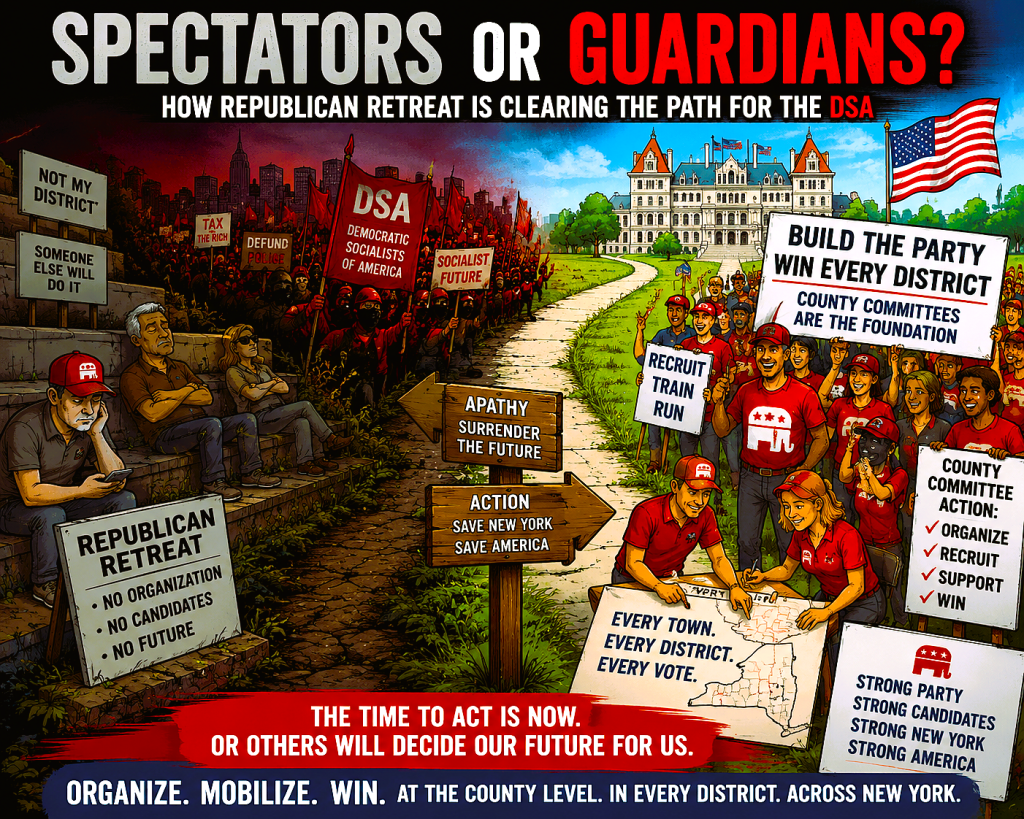
For too long, too many Republican organizations have acted like spectators watching New York politics unfold around them rather than guardians of our Republic charged with defending it.
The committee process was designed to prevent exactly this kind of decline.
The Democratic Socialists understood this lesson and used the system exactly as it was designed to be used. Republicans allowed the system to wither.
Political vacuums do not remain empty for long. If Republicans refuse to organize, recruit, and compete, someone else will gladly occupy that space.
Political parties are not supposed to surrender territory. They are supposed to compete for it.
The greatest threat facing New York Republicans in 2026 is not the Democratic Party, the DSA, or changing demographics. It is the belief that entire sections of New York are no longer worth fighting for.
History has shown repeatedly what happens when one side stops showing up.
Someone else always takes their place.
Steve Gillan is Director of Political Affairs, Project Civica, Inc.
SteveG@projectcivica.org