By Phil Orenstein
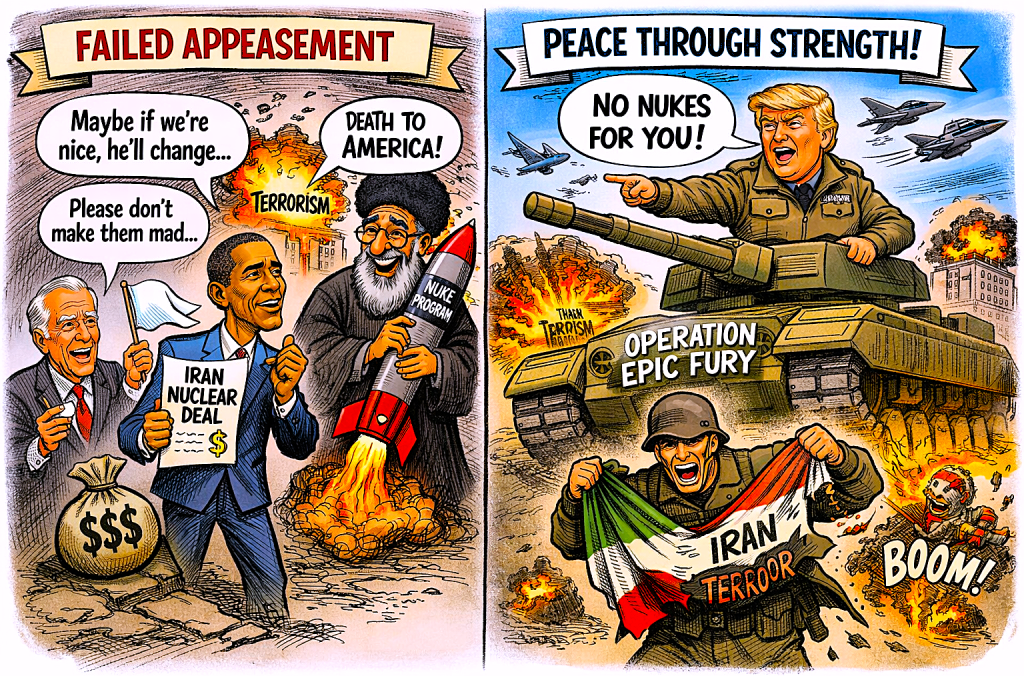
ChatGPT generated image
I was raised in a Democratic family and remained a Democrat until 20 years ago. But that Democrat Party no longer exists. Where is the Democrat party of FDR, Truman, and JFK, resolute fighters against Nazi Germany, Fascism, and Communism who put America first? Today, they’ve become the party of appeasement and “America last.”
For nearly half a century, every American president from Ronald Reagan onward, and all Democrat administrations, have identified Iran as the world’s leading state sponsor of terrorism. That judgment has never been partisan. It has been a consistent recognition of reality.
Iran’s regime has been responsible for the deaths of hundreds of Americans over the past 47 years. It has funded and directed terrorist proxies like Hamas and Hezbollah, fomenting violence and hostilities against Israel and across the Middle East. At home, it rules through brutality, enforcing its will with “morality police” who arrest, torture, and even kill women for defying dress codes, executing dissidents, and persecuting minorities in a ruthless effort to extinguish freedom and dissent. This is the historical record.
Equally consistent has been another bipartisan truth: Iran must never be allowed to obtain nuclear weapons. Since the presidency of Bill Clinton, that principle has been stated clearly by leaders of both parties. Yet for decades, it remained a warning without decisive action—until President Donald Trump.
Today, critics argue that confronting Iran is a “war of choice,” not necessity. Some claim it is driven by politics or foreign influence. But this moment is not about politics. It is about policy, and the disastrous consequences of choosing wrongly.
History offers a stark lesson. In 1938, British Prime Minister Neville Chamberlain faced a rising threat in Nazi Germany. Adolf Hitler demanded control of the Sudetenland, a region of Czechoslovakia. Chamberlain chose appeasement, believing that conceding territory would preserve peace. He returned to Britain after signing the Munich Agreement, declaring he had secured “peace for our time.”
Within months, Hitler violated the agreement, seized the rest of Czechoslovakia, and continued his march across Europe. Appeasement did not prevent war—it accelerated it. By the time the world recognized the full danger, it was too late. World War II followed, costing more than 50 million lives.
The lesson is clear: when aggressive regimes are met with weakness, they do not moderate—they advance. That lesson applies directly to Iran.
Today, Iran stands closer than ever to nuclear capability. International assessments indicate that it possesses a significant stockpile of uranium enriched to 60%. Weapons-grade enrichment requires roughly 90%. Experts estimate that Iran could reach that threshold in a matter of days or weeks—not years. That means the technical capability to produce at least 10 bombs. More concerning than what we know is what we do not know. Delay and appeasement now is not the right choice.
President Trump recognized this reality. During his first term, he withdrew from the nuclear agreement with Iran and implemented a strategy of maximum economic pressure. In 2020, he authorized the strike that eliminated Qassem Soleimani, the architect of Iran’s global terror network. These actions were strategic efforts to weaken Iran’s ability to project power and destabilize the region. Now, as Iran approaches the nuclear threshold, decisive action has again been taken. The objective of Operation Epic Fury is straightforward: to ensure that the world’s leading state sponsor of terrorism never acquires nuclear weapons.
The alternative approach—appeasement—has already been practiced by both Presidents Obama and Biden. Economic concessions, sanctions relief, and diplomatic overtures of the disastrous Iran nuclear deal, JCPOA, did not halt Iran’s ambitions. Instead, they provided the regime with resources to strengthen its military, expand its influence, and continue its pursuit of nuclear capability.
Appeasement rests on the hope that adversaries will change their behavior if given incentives. But barbarian regimes that define themselves through opposition to the United States and chant “Death to America,” are not easily persuaded by goodwill. When met with concession, they interpret it as weakness.
This pattern is not unique to Iran. In recent decades, a series of foreign policy decisions have reinforced a global perception of American weakness. Obama’s failure to enforce declared “red lines” in Syria, the chaotic withdrawal from Afghanistan under Biden, and muted responses to authoritarian aggression have all contributed to the perception that the United States is a “paper tiger.”
Perception matters in international affairs. When adversaries believe that America will not act decisively, and fail to put America first, they are more likely to do evil and create conflict and war. Strength, and bold action, by contrast, can deter it.
This is the question: which approach is more likely to prevent a nuclear-armed Iran, and the catastrophic consequences that would follow? History suggests that strength, clarity, and timely action are more effective than delay, concession, and appeasement policies. The earlier a threat is confronted, the easier it is to contain. The longer it is ignored, the more costly it becomes.
A nuclear-armed Iran would fundamentally alter the balance of power in the Middle East. It would embolden its proxies, threaten U.S. allies, and introduce the risk of nuclear proliferation across the region. The danger of Iran acquiring nukes is unimaginable. Preventing that outcome, and potentially the next world war, is not merely a strategic objective. It is a necessity.
There was a time when Americans, regardless of party, would unite in the face of such threats. During World War II, the Cold War, and in the aftermath of September 11, political divisions gave way to uniting for the ultimate cause of national security and America always came first.
That unity has eroded. Today, even fundamental questions of defense and deterrence are filtered through partisan lenses. Today’s Democrat party views Trump as the enemy, the authoritarian ruler, the threat to Democracy. It seems they would rather have us lose a war, and have Trump fail, than to allow him to win again and see his approval numbers rise. They put America last.
The challenge posed by Iran is not a partisan issue. It’s the same choice faced by earlier generations: confront danger while it is still manageable, or postpone action until it becomes overwhelming. Appeasement offers comfort and a transitory peace, while strength and bold action demand difficult decisions, but can prevent far greater consequences and potential world wars.
History has already rendered its verdict. President Trump understands the lessons of history and will continue the mission until Iran’s nuclear capabilities are annihilated. Trump is leading the fight for national security and the future of America and Western Civilization, due to his no-appeasement policies of bold action, strength, rejecting concessions, and putting America first. We must stand with President Trump!
Phil Orenstein is the president of the Queens Village Republican Club. Established in 1875, it is America’s oldest Republican Club. www.QVGOP.org